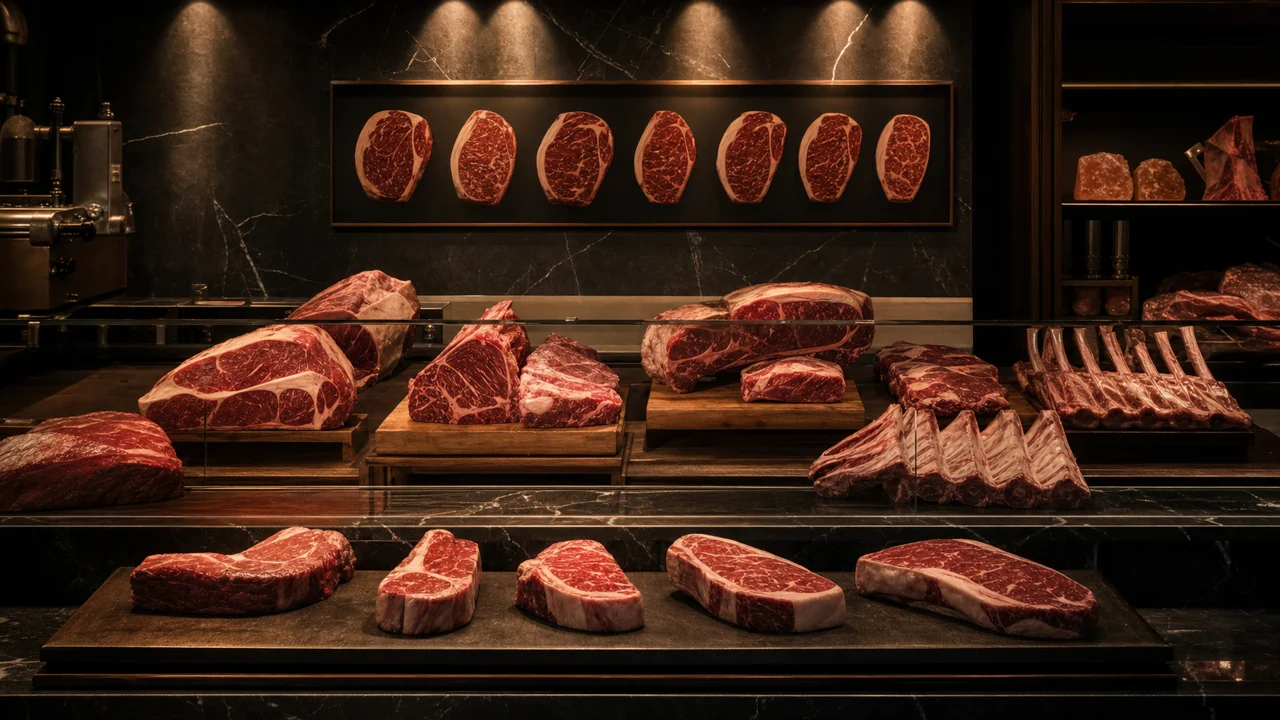
A skilled butcher reads a piece of meat the way a sommelier reads a wine — systematically, from the outside in, building a complete picture before committing to a purchase or a cook. There are five observable signals — color, marbling pattern, fat cap, grain orientation, and smell — that, taken together, reveal provenance, handling, age, and likely cooking behavior long before you slice the cut open. Develop this visual literacy and you gain the ability to assess quality at the butcher counter in under sixty seconds, protecting yourself from overpriced mediocrity and directing your attention toward the cuts that genuinely merit a premium price.
Color: Reading Freshness and Age in the Muscle
Fresh beef on a newly exposed cut surface displays the cherry-red of oxymyoglobin — the compound formed when myoglobin, the oxygen-storing protein in muscle, binds atmospheric oxygen. This bloom signals freshness and is the color that retail display lighting is designed to enhance. Vacuum-sealed beef, by contrast, presents as deep purple-red: deoxygenated myoglobin in the absence of oxygen. This is not a defect. Return the cut to ambient air and within 20–30 minutes the surface will re-oxygenate and bloom back to cherry-red. Many premium butchers sell sub-primals under vacuum precisely because the oxygen-free environment extends shelf life without compromising quality.
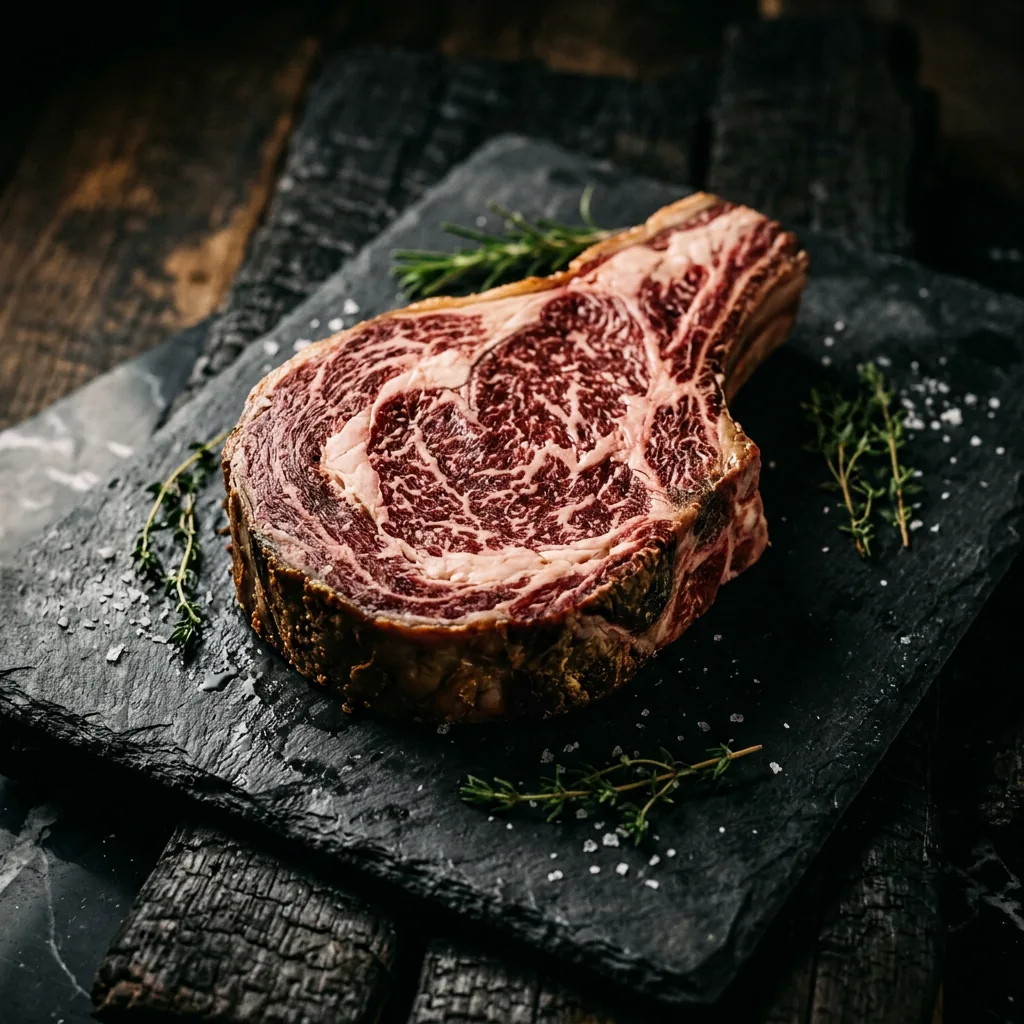
Surface browning — metmyoglobin — is the oxidation product of myoglobin and is time-dependent. A cut with browning penetrating past the first trimmed millimeter has been sitting too long. On a dry-aged ribeye, however, the external pellicle should be dark brown to near-black — controlled surface desiccation that concentrates flavor and develops the complex nutty, funky notes of extended aging. Cut through the pellicle and the interior should be deep, vibrant red. If the interior is also brown or grey, the aging environment was compromised.
Fat color deserves independent attention. Premium grain-fed beef should carry white to very pale cream fat. Yellow fat signals carotenoid accumulation from a grass-fed or grass-finished animal or from an older animal with prolonged beta-carotene exposure. Neither is a flaw in itself, but both change how the fat will render and how the cut will taste.
| Signal | Ideal appearance | What deviation means |
|---|---|---|
| Lean color | Cherry-red (bloom) or deep purple-red (vacuum) | Brown surface = age or oxidation |
| Fat color | White to pale cream | Yellow = grass-fed or older animal |
| Dry-aged crust | Dark brown-black pellicle | Grey interior = aging fault |
| Vacuum seal odor | Slightly lactic, dissipates on opening | Persistent sour = spoilage |
Marbling Pattern: The Geometry of Quality
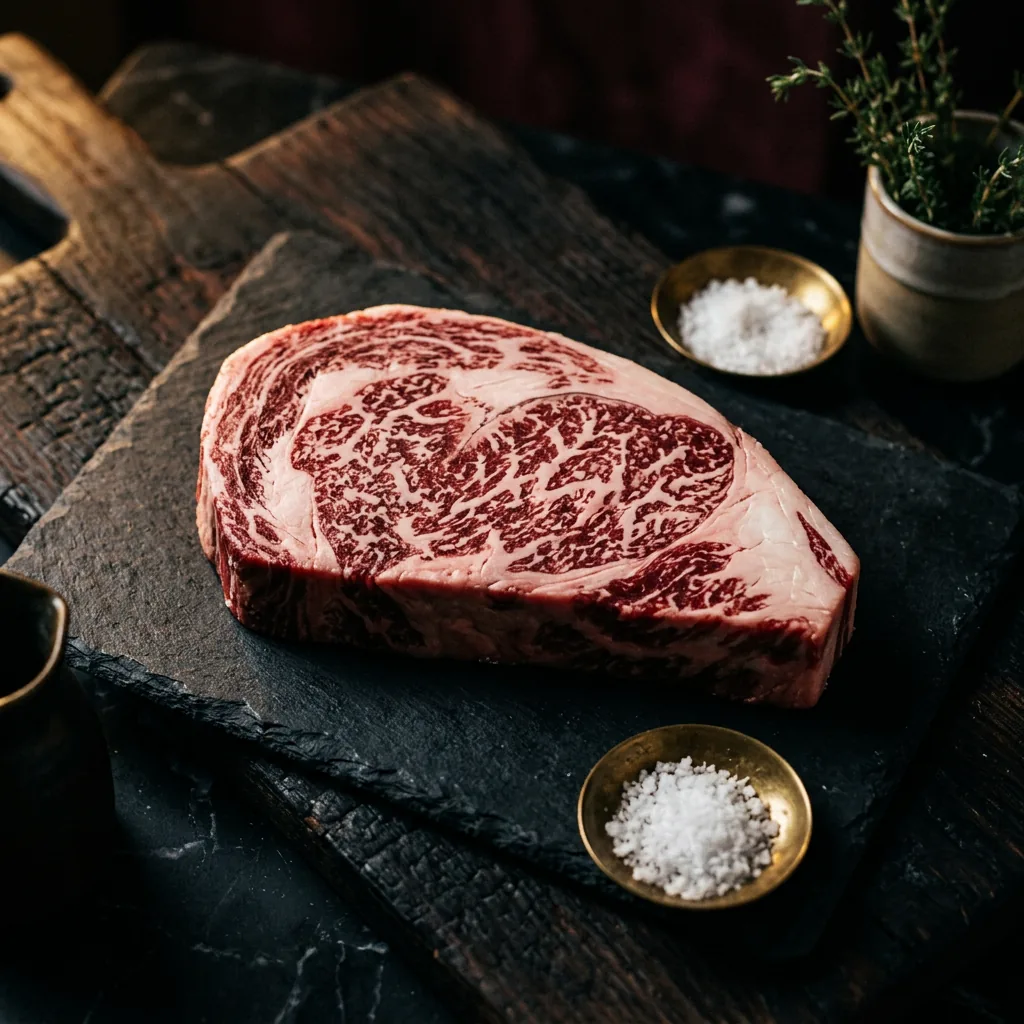
Not all intramuscular fat is equal, and the spatial distribution of marbling matters as much as its quantity. Fine, evenly distributed flecks of fat throughout the lean muscle matrix are the gold standard: during cooking, they render progressively and baste each muscle fiber from within, distributing moisture and richness uniformly. Coarse marbling concentrated in large pockets renders unevenly, leaving some zones greasy and others dry within the same steak.
To assess marbling accurately, hold the cut at eye level with a light source behind it. Fine marbling catches light uniformly and gives the lean surface a slightly shimmering texture. For a ribeye, the spinalis dorsi cap should be well-marbled and visually distinct from the eye. The eye itself should display visible marbling throughout — a uniformly red eye with no fat flecks indicates a leaner animal or a cheaper cut misrepresented as ribeye. For a wagyu a5 ribeye, the marbling should be so dense that the surface reads almost white with a red matrix rather than red with white punctuation.
Pro tip: When the fat cap and the lean muscle look like they belong to the same animal — same trim quality, same care, same color logic — the steak was handled with consistent professionalism throughout. Discrepancies between the fat and the lean tell a more complicated story.
Fat Cap: The Butcher's Signature and Cold Chain Indicator
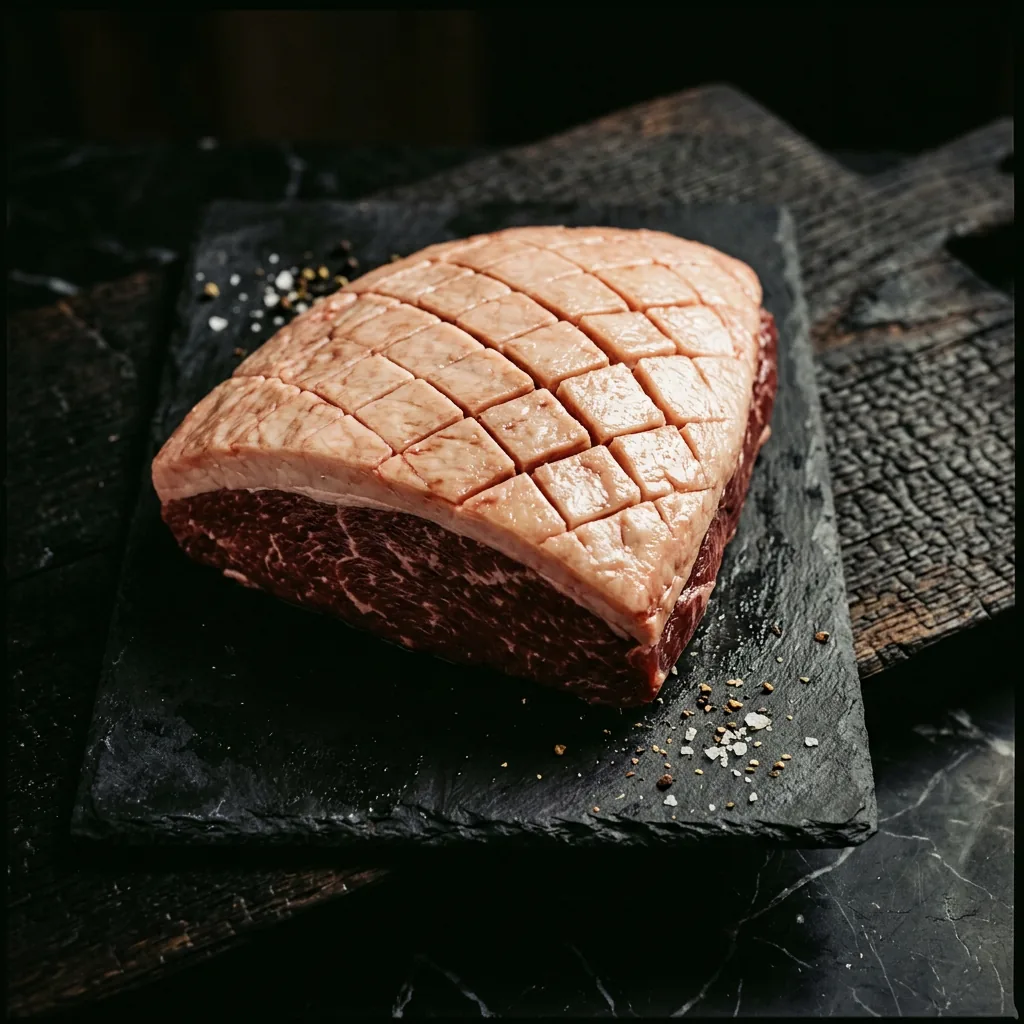
A premium sub-primal carries a fat cap between 0.5 and 1.2 cm in thickness, white, with clean and consistent trimming edges. Butchers who are proud of their product leave a proper cap — it insulates the lean during aging, protects it from oxidation, and renders during cooking to baste the surface. Aggressive trimming often conceals oxidized or mishandled fat beneath.
The structure of the cap matters as much as its thickness: it should separate from the underlying muscle in a single coherent layer, without tearing or showing a wet, compromised interface. A stringy, fractured fat-to-muscle junction is one of the most reliable signs of repeated freeze-thaw cycling, which damages both fat cells and muscle fiber membranes and degrades cooking performance.
Grain Direction: The Butchery Test That Never Lies
The visible muscle fibers — the grain — should run perpendicular to the cut face on a correctly portioned steak. Short, transverse grain means you will slice against the fibers after cooking, shortening them and maximizing tenderness. Long grain — fibers running parallel to the cut surface — means the sub-primal was portioned incorrectly, and no level of doneness compensates for the resulting toughness.
This test is particularly consequential for picanha, flank steak, and skirt steak — cuts where grain orientation defines the eating experience more than marbling does. A beautifully marbled picanha portioned with the grain running lengthwise requires significant jaw effort regardless of how precisely it was cooked.
Pro tip: Run your finger lightly across the cut surface in two perpendicular directions. Against the grain feels slightly rough, like brushed velvet. With the grain feels smooth. The rough direction is your slice direction after cooking — and ideally perpendicular to the cut face.
Smell: The Information the Eyes Cannot Provide
Fresh beef smells faintly metallic — clean, almost mineral, neutral. Any sour, acidic, or ammoniated note indicates bacterial activity beyond acceptable surface counts. A mild lactic note in vacuum-packed beef is normal and expected: lactic acid bacteria produce it under anaerobic conditions and it dissipates within minutes of opening the package.
Dry-aged beef commands its own aromatic vocabulary. A well-aged cut — 28 to 60 days in controlled conditions — should smell of blue cheese rind, toasted bread, oxidized butter, and mineral earthiness. This aroma should come from the dark external pellicle, not the fresh interior once exposed. If the fresh-cut interior carries an aggressive ammonia note, the aging process crossed from controlled into spoiled.
Beyond Beef: Transferring the Framework
The same five-signal assessment transfers across species with modest adjustments. Lamb lean muscle should be dark red-pink, firmer and denser than beef, with white fat and a specific lanolin-and-herb aroma in well-raised animals. Pork should be pale pink to rose, with white fat that holds its form at room temperature. Game — venison loin, wild boar — should be deep purple-red with the dense, mineral-forward smell of wild animal; any sourness that does not dissipate indicates inadequate hanging or improper cold-chain management.
The principles are universal because the biology is universal. Myoglobin behaves the same way across mammalian species. Collagen distribution follows the same activity-driven logic. Once you can read a wagyu a5 ribeye correctly, you can read a roe deer saddle with the same confidence — and that literacy, built at the counter, is what separates the informed buyer from everyone else in the queue.
Summary
Quality assessment at the butcher counter is a learnable, systematic discipline. Evaluate color for freshness and aging stage; assess marbling for distribution geometry, not just quantity; inspect the fat cap for trimming consistency and cold-chain integrity; confirm grain direction before committing; and smell the exposed surface for the clean mineral neutrality of fresh protein or the controlled complexity of correct dry aging. Apply these five signals in sixty seconds, and price becomes a secondary consideration rather than the primary guide.