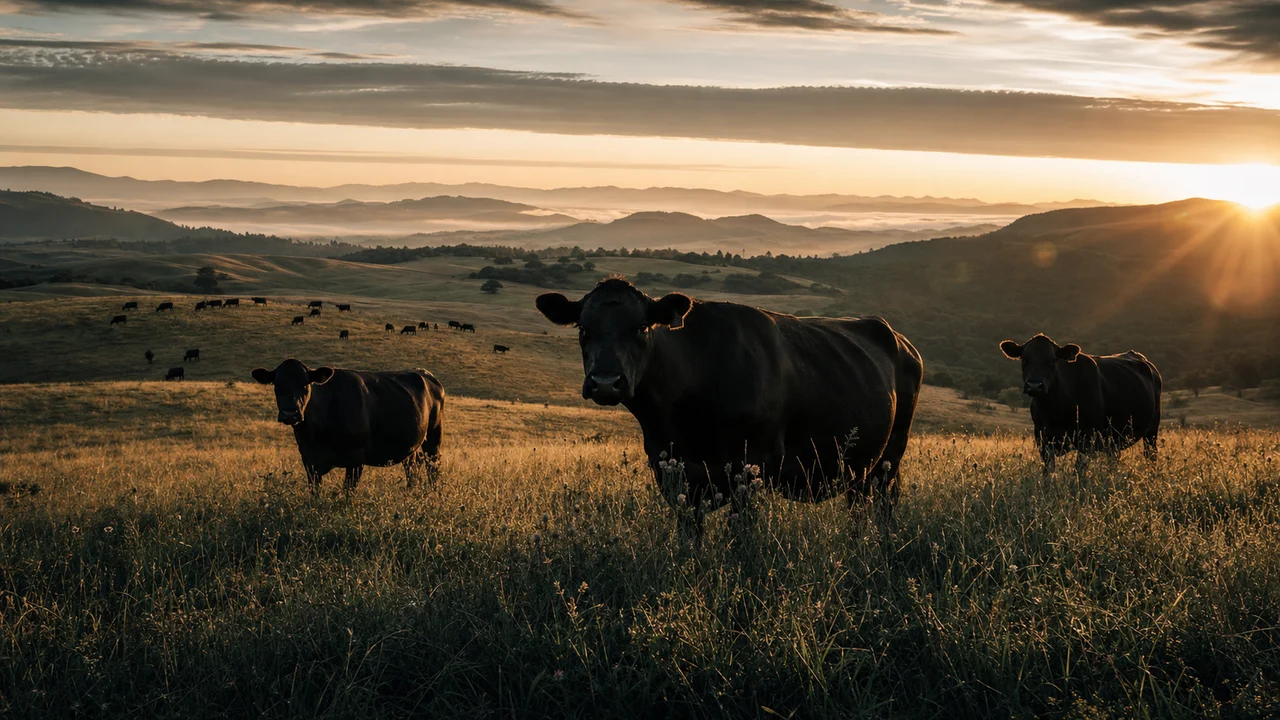
The global meat industry sits at the intersection of food security, environmental impact, animal welfare, and cultural tradition. Understanding these dimensions is not about ideology — it is about making informed, effective choices in a complex system. A premium meat consumer who has invested in understanding marbling grades, cooking technique, and cut selection owes it to themselves, their suppliers, and the planet to engage with this complexity honestly. The good news: the most sustainable choices and the best-tasting choices frequently coincide, particularly in the premium and heritage segments of the market.
The Carbon Footprint of Meat — By the Numbers
Beef has the highest greenhouse gas intensity of any food we produce, generating approximately 27–60 kg of CO₂ equivalent per kilogram of retail beef depending on production system. The range is wide and consequential:
| Protein Source | GHG Emissions (kg CO₂e/kg) | Primary Driver |
|---|---|---|
| Grain-fed feedlot beef | 40–60 | Feed crop production + enteric fermentation |
| Grass-fed beef (average) | 27–45 | Enteric fermentation + land use |
| Well-managed regenerative beef | Potentially 10–20 | Partially offset by soil carbon sequestration |
| Lamb | 20–30 | Enteric fermentation (smaller body, similar process) |
| Pork | 7–12 | Less fermentation; more efficient feed conversion |
| Poultry | 4–6 | Most efficient land and feed conversion |
These figures gain proper meaning through context. A single weekly beef meal at 200 g contributes roughly 5–8 kg CO₂e per week — less annual footprint than a single short-haul flight. The actionable question is not whether to eat beef, but which beef, from which system, how frequently, and how much of the animal.
Regenerative Agriculture: Meat as an Environmental Tool
The emerging discipline of regenerative grazing reframes livestock not as a categorical environmental liability but as a potential ecological tool. When managed correctly through rotational grazing, mob grazing, and holistic planned grazing protocols, ruminants can accelerate the carbon cycle in ways that benefit soil health over time.
The mechanism: resting pasture between grazing periods allows grasses to regrow their root mass, depositing organic carbon deep into the soil. Herd impact — trampling of vegetation into the surface — accelerates decomposition and mimics the natural behavior of migratory wild herds that once covered these grasslands. Over years and decades, properly managed grazing can increase soil organic carbon percentages, restore water infiltration in compacted land, rebuild biodiversity, and potentially offset a significant fraction of the herd's enteric methane emissions.
Organizations including the Savory Institute and Rodale Institute document cases where well-planned grazing has reversed desertification and rebuilt topsoil over 10–20-year periods. This stands in direct contrast to continuous overgrazing, which compacts soil, reduces plant diversity, and accelerates erosion — demonstrating that management quality matters far more than the simple presence of cattle.
Pro tip: Certifications that independently verify regenerative claims include Land to Market (Savory Institute's Ecological Outcome Verification system), Certified Grassfed by A Greener World, and Pasture for Life (UK). These are the most rigorous third-party verifications currently available. A regenerative claim without third-party audit is marketing, not evidence.
Animal Welfare: Certifications That Actually Mean Something
The certification landscape ranges from baseline compliance assurances to comprehensive third-party audit systems with unannounced inspections. Understanding which is which matters for informed buying.
Europe: - RSPCA Assured (UK) — independently inspected against species-specific standards; the most recognized UK welfare label; covers cattle, pigs, sheep, and poultry - Label Rouge (France) — historically rigorous for poultry; outdoor access required; independently audited; the benchmark for French free-range chicken - EU Organic — includes animal welfare requirements but is primarily a farming inputs certification; welfare standards vary by certifier
United States: - Certified Humane — third-party inspected; meaningful space, shelter, and behavioral expression requirements; the most widely distributed meaningful US welfare label - Animal Welfare Approved (AWA) by AGW — the most stringent US welfare certification; mandatory pasture access throughout the season; small-farm focused - Global Animal Partnership (GAP) Steps 1–6 — a tiered system where Step 5+ (pasture-raised, at least 4 months outdoor access) is the meaningful welfare threshold
Welfare certification at the premium level is increasingly expected by European consumers. The distinction that matters most: third-party inspected vs. self-declared. Only logos representing real, unannounced audits carry genuine supply chain integrity.
Pro tip: In Germany, look for the Neuland label — widely considered stricter than EU Organic for livestock welfare. For premium British beef, RSPCA Assured combined with Red Tractor provides both welfare and traceability assurance in a single purchase.
Heritage Breeds and Genetic Diversity
Heritage and indigenous livestock breeds represent millennia of landscape-specific adaptation. They are typically:
- Slower-growing and better suited to extensive, low-input systems on marginal land
- More disease-resistant, requiring fewer veterinary interventions over productive lives
- Producers of higher-fat, more complex-flavored meat than fast-growing commercial breeds optimized for feed conversion
- Genetically irreplaceable — each breed lost is a permanent loss of adaptive traits
Notable heritage beef breeds: Belted Galloway, Scottish Highland, Dexter, Red Devon, White Park (UK); Gelbvieh, Pinzgauer (Central Europe); Rubia Gallega (Spain). Each carries distinctive carcass characteristics, fat composition, and flavor profile.
Notable heritage pork: Mangalitza (Hungary/Austria) — the highest-fat pork breed in Europe, producing extraordinary lard and richly marbled meat; Ibérico pigs (Extremadura and Andalusia) — the source of Jamón Ibérico de Bellota, one of the world's most complex cured meat products; Berkshire (Kurobuta) — the Japanese premium pork standard.
Choosing heritage breed meat from small-scale producers supports genetic diversity in the food supply — a resilience consideration that extends well beyond flavor and welfare into long-term food security in the face of climate variability.
Nose-to-Tail: The Most Effective Individual Choice
The single most impactful action a premium meat consumer can take is eating more of the animal — including offal, cheeks, tongue, marrow bones, and secondary cuts that the Western premium market systematically undervalues.
A typical beef carcass yields only 40–50% in the premium primal cuts sought by Western consumers. The remaining 50–60% is exported to other markets, processed into pet food, or lost to industrial use. When Western consumers value the whole animal, farmers receive fair economic return from a larger proportion of each carcass, making ethical, premium production economically viable without requiring every consumer to pay prime prices for every meal.
Practically: add Beef Tongue, Ox Tail, Beef Heart, Beef Marrow Bones, chicken livers, and lamb neck to your cooking repertoire. These cuts are typically less expensive, richly flavored, and consistently more sustainable than equivalent primal cuts from the same animal and the same farm.
Traceability: From Farm to Fork
Premium meat traceability allows a buyer to trace their purchase to a specific farm, animal, and birth date — a standard that increasingly defines the premium segment and is becoming a consumer expectation rather than a luxury.
| System | Level of Traceability |
|---|---|
| Japanese A5 Wagyu (JMGA) | Individual animal: birth, movement, feeding, processing |
| UK Red Tractor | Batch-level; farm assurance but not individual animal |
| EU beef retail labeling | Country of birth, rearing, and slaughter mandatory |
| RSPCA Assured | Farm-level inspection; batch traceability |
| Direct farm purchase | Maximum traceability; full provenance history available |
Apps and digital platforms that link cut profiles to producer provenance, certification badges, and geographic origins are rapidly raising consumer expectations. The premium meat buyer who demands traceability creates economic incentives that cascade from retailer to processor to farmer to land manager — demand-side accountability that reaches the entire supply chain.
Pro tip: When buying direct from a farm or at a farmers' market, ask three questions: What breed? How was it fed and finished? Can you trace this animal? A producer who answers all three confidently and specifically — "Hereford cross, grass-finished for 18 months on herb-rich pasture, individual tag number available" — is the producer worth supporting.
Five Principles for Ethical Meat Buying
- Buy less, buy better — reduce frequency and portion size; redirect the budget to higher-welfare, higher-traceability production. This simultaneously reduces environmental footprint and financially supports producers who cannot compete on volume
- Eat the whole animal — rotate Beef Tongue, offal, Lamb Rack offcuts, and Short Ribs into your repertoire alongside premium cuts. The whole-animal economy makes ethical production viable
- Buy direct from producers — farm shops, butcher subscriptions, and farmers' market relationships maximize producer income share and provide authentic provenance
- Demand third-party certification — Pasture for Life, Certified Grassfed, Certified Humane, RSPCA Assured, Land to Market. The logo represents a real audit; the claim without it represents only marketing
- Think seasonally and regionally — game in autumn and winter, spring Lamb Rack in early summer, heritage pork in cooler months; seasonal eating aligns with natural production cycles and typically delivers superior flavor at lower environmental cost
Summary
Sustainable and ethical meat sourcing is not a simple calculation, but it is a navigable one. The key variables are the production system (regenerative vs. conventional), welfare certification (third-party audited vs. self-declared), breed and genetic diversity, whole-animal consumption patterns, and traceability. In the premium meat market, these variables align more favorably than in the commodity market — the farmer charging a premium for certified grass-finished, heritage breed beef is, in almost every case, also running a more sustainable, higher-welfare operation. The premium buyer's single most powerful tool is informed demand: buy with full knowledge of the supply chain, ask for certification, eat more of the animal, and support the farmers who are doing it right.