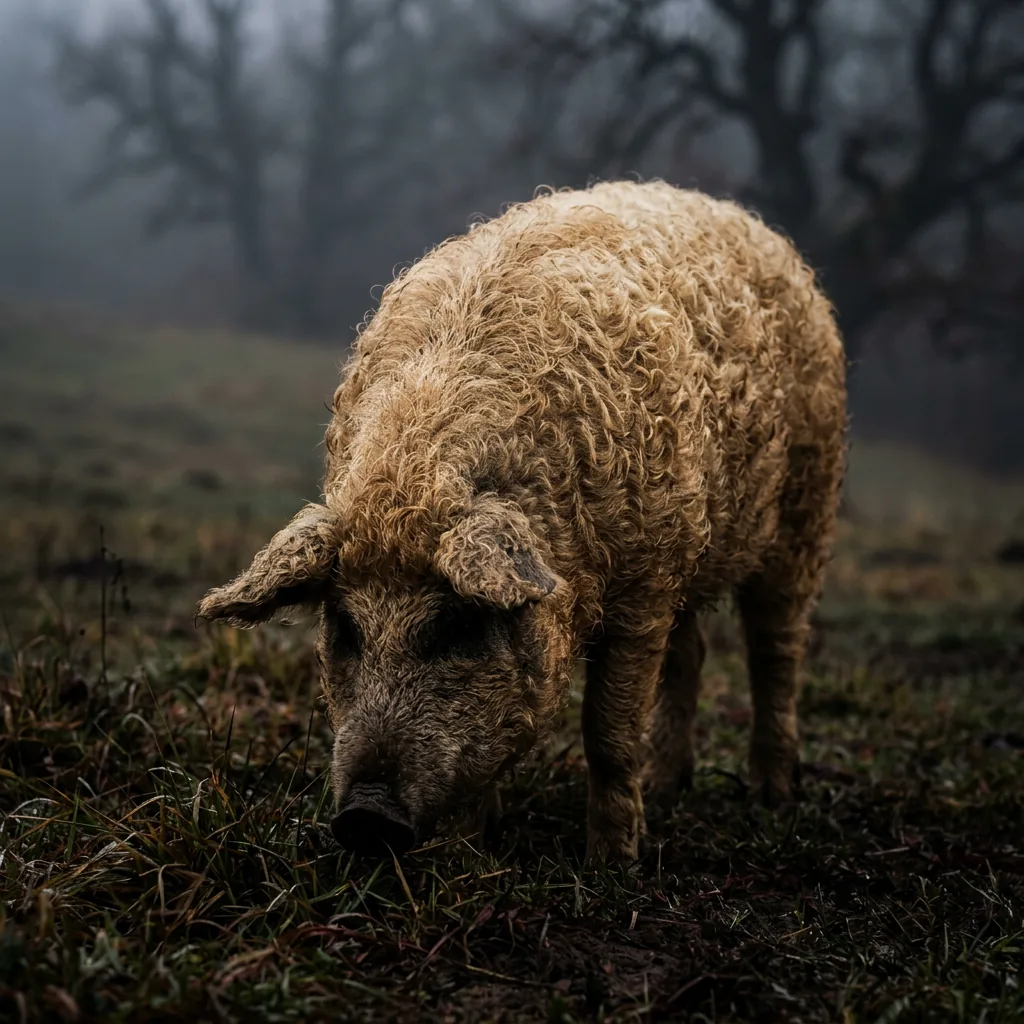
About the breed
Often referred to as the 'Kobe beef of pork,' the Mangalitsa is a rare heritage breed celebrated for its extraordinary fat quality and curly, fleece-like coat. It is a true 'lard-type' pig, prized by Michelin-starred chefs and master charcutiers for its deep, complex flavor and creamy texture. Unlike modern lean breeds, it represents the pinnacle of traditional swine genetics, offering a culinary experience defined by richness rather than volume.
Roots & Heritage
Developing in the Austro-Hungarian Empire around 1833, the breed resulted from crossing Hungarian Bakonyi and Szalontai pigs with the Serbian Sumadija. It flourished for a century as the primary source of cooking fat in Central Europe before falling into near-extinction during the industrialization of agriculture. Today, it enjoys a prestigious revival, particularly in Hungary, where it is managed under strict quality controls to preserve its unique heritage.
Meat Profile
The meat is strikingly dark red, resembling beef more than conventional pork, and features intense intramuscular marbling. Its most defining characteristic is the thick, snow-white backfat, which is high in monounsaturated fats and melts at a significantly lower temperature than other breeds. This results in a silky mouthfeel and a clean, nutty flavor profile that lingers on the palate.
In the Kitchen
Due to the high fat-to-lean ratio, Mangalitsa requires a specialized approach—high heat should be used sparingly to avoid excessive smoke from the melting lard. It is unparalleled for long-term curing, such as lardo or ham, where the fat undergoes a transformative enzymatic aging process. For fresh cuts, low-and-slow techniques or thick-cut pan-searing are recommended to properly render the fat while keeping the meat succulent.