The Maillard reaction is the chemistry behind every great steak — and behind every disappointing one. Discovered in 1912 by French physician Louis-Camille Maillard, it is a non-enzymatic browning reaction between amino acids and reducing sugars that begins in earnest when the surface of the meat exceeds 140°C and is dry enough to actually reach that temperature. Below that threshold, you are merely heating meat; above it, you are transforming it at a molecular level into something fundamentally more complex. No other single chemical reaction has more impact on the flavor, aroma, and visual appeal of cooked beef — and understanding its mechanics gives you direct, actionable control over every steak that leaves your kitchen.
The Chemistry in Detail
When a dry meat surface surpasses 140°C, free amino groups in the muscle proteins — particularly the ε-amino groups of lysine residues — react with the carbonyl groups of reducing sugars like glucose and ribose. This initial condensation produces a highly unstable Amadori product, which then rearranges, fragments, and recondenses in a branching cascade. The final pool of compounds is enormous: pyrazines contribute roasted, nutty notes; furans bring caramel and toasty character; thiophenes and thiazoles deliver sulfurous, meaty depth; oxazoles add green and vegetable nuance; and melanoidins — the large, brown polymeric pigments — are responsible for the mahogany color of a perfect crust.
This is emphatically not caramelization, though the two reactions are often conflated. Caramelization is the thermal breakdown of sugar alone and requires no amino acids; it occurs at 160–180°C and contributes its own sweet, amber notes. Both reactions run simultaneously in a hot pan, but the Maillard cascade is responsible for the characteristic complexity of seared meat. It is equally important to understand what the Maillard reaction cannot do: it penetrates no more than one to two millimeters into the surface. Every aromatic compound — every pyrazine, every melanoidin — lives exclusively in the crust. The interior of a ribeye owes its flavor to the meat's own fat chemistry and heat-driven protein changes, not to Maillard browning. This is precisely why crust thickness, evenness, and intensity matter so much: the crust is irreplaceable, and it is finite.
The Water Problem
Water boils at 100°C. As long as moisture is present on the surface of the meat, every joule of energy delivered by the pan is consumed evaporating that water rather than driving the Maillard cascade. Surface temperature cannot exceed 100°C while liquid water remains — and 100°C is 40°C below the Maillard threshold. A wet steak dropped into even a blazing hot pan will steam for the first 30 to 45 seconds while the surface dries, delaying browning and producing a pale, boiled exterior zone rather than a crust. The pan temperature drops precipitously, compounding the problem.
The two-part solution is non-negotiable in professional kitchens: pat the surface completely dry with paper towels immediately before cooking, and — for best results — salt the steak 24 to 48 hours in advance and leave it uncovered on a wire rack in the refrigerator. The salt draws moisture out by osmosis, then reabsorption into the meat over several hours redistributes that moisture while seasoning the interior; the refrigerator's cold, circulating air desiccates the surface further. The pellicle that forms is noticeably drier than any freshly patted surface and will brown faster, more evenly, and more deeply.
Pro tip: Salt 24 hours ahead and leave uncovered on a wire rack in the refrigerator. The pellicle that forms will brown faster and more evenly than any freshly-salted surface, and the interior will be seasoned throughout — not just at the outer millimeter.
Pan Selection and Heat Management
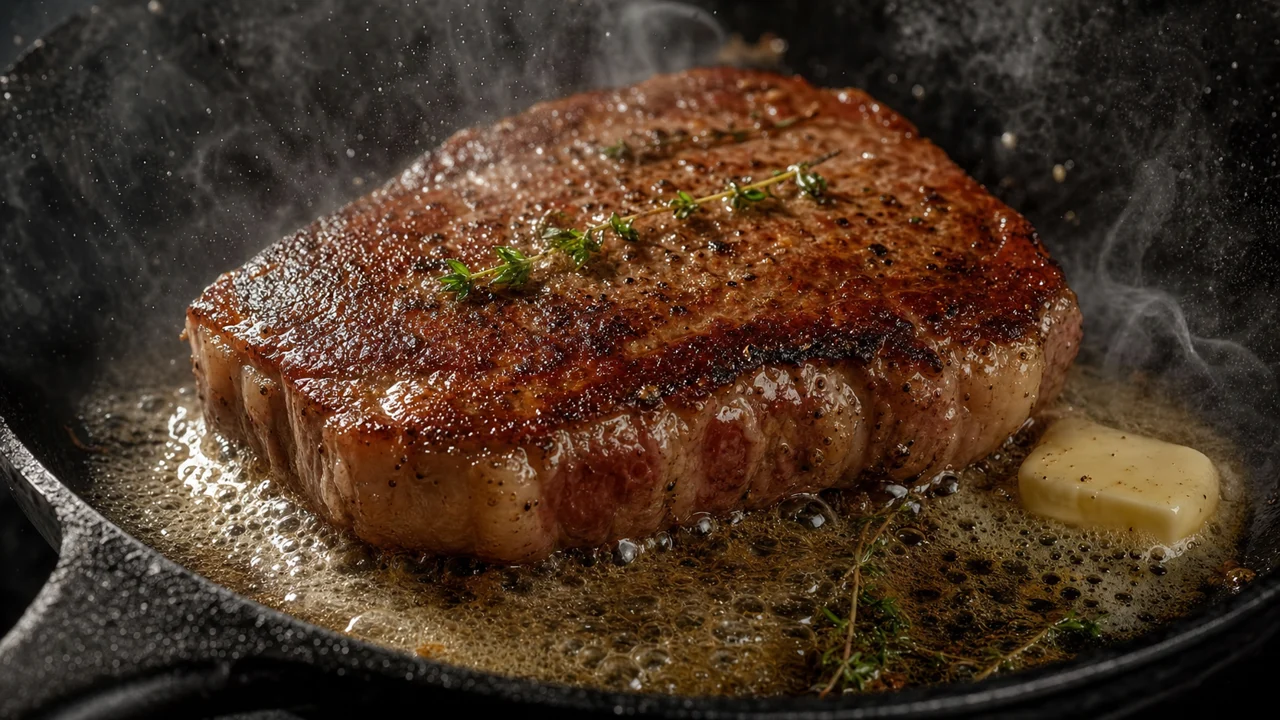
Not all cooking vessels are equal partners in the Maillard reaction. Cast iron and carbon steel both retain heat exceptionally well and recover temperature rapidly after cold meat hits the surface — critical, because a steak at 2–4°C carries significant thermal mass and will cool a thin stainless pan by 30–50°C on contact. That temperature drop extends the steaming phase and delays browning. Cast iron, preheated for 5–8 minutes over high heat, maintains surface temperature above 200°C through contact, keeping Maillard conditions active from the first second.
Oil selection matters for a related reason. Butter burns at 150°C, olive oil at 190–200°C — both are below the pan temperatures needed for optimal Maillard activity. Refined avocado oil (smoke point ~270°C), grapeseed oil (~215°C), or beef tallow (~250°C) are the professional choices. A thin film of high-smoke-point fat ensures the heat transfer surface stays clean and active; a thick layer of fat insulates the meat surface, slowing browning.
Pro tip: A drop of water flicked into the preheated pan should bounce violently and evaporate within a second. If it simmers calmly, the pan is not yet hot enough — wait another 60–90 seconds. Patience in preheating is among the most valuable habits in meat cookery.
Flipping Frequency and Crust Development
A persistent debate in steak cookery concerns flipping frequency. The once-per-side school argues that leaving the steak undisturbed allows a continuous crust to develop without interruption. The frequent-flip school — supported by food scientist Harold McGee and later popularized by J. Kenji López-Alt — argues that flipping every 30 seconds distributes heat more evenly, prevents the outer layers from overcooking while the center climbs, and produces a marginally more even crust on thick cuts.
Both approaches work. For cuts under 2.5 cm, a single flip is sufficient and produces a more visually dramatic sear. For thick cuts over 3.5 cm — a tomahawk or bone-in porterhouse — frequent flipping reduces the risk of the overcooked grey band while the center climbs, without sacrificing crust quality. The crust continues developing on each pass because the surface temperature is still above 140°C when it returns to the pan.
The Butter Basting Window
Butter enters the pan only in the final 60–90 seconds. Added earlier, the milk solids burn black and bitter, producing acrolein and other off-flavors that contaminate the crust. Added in the final window, the butter foams and browns, coating the surface in its own Maillard products — browned milk solids (beurre noisette) — which intensify the crust with a nutty, almost hazelnut register impossible to replicate with other fats alone. Garlic and thyme release their volatile aromatics rapidly in the hot butter, transferring them to the meat surface in the brief remaining cook time.
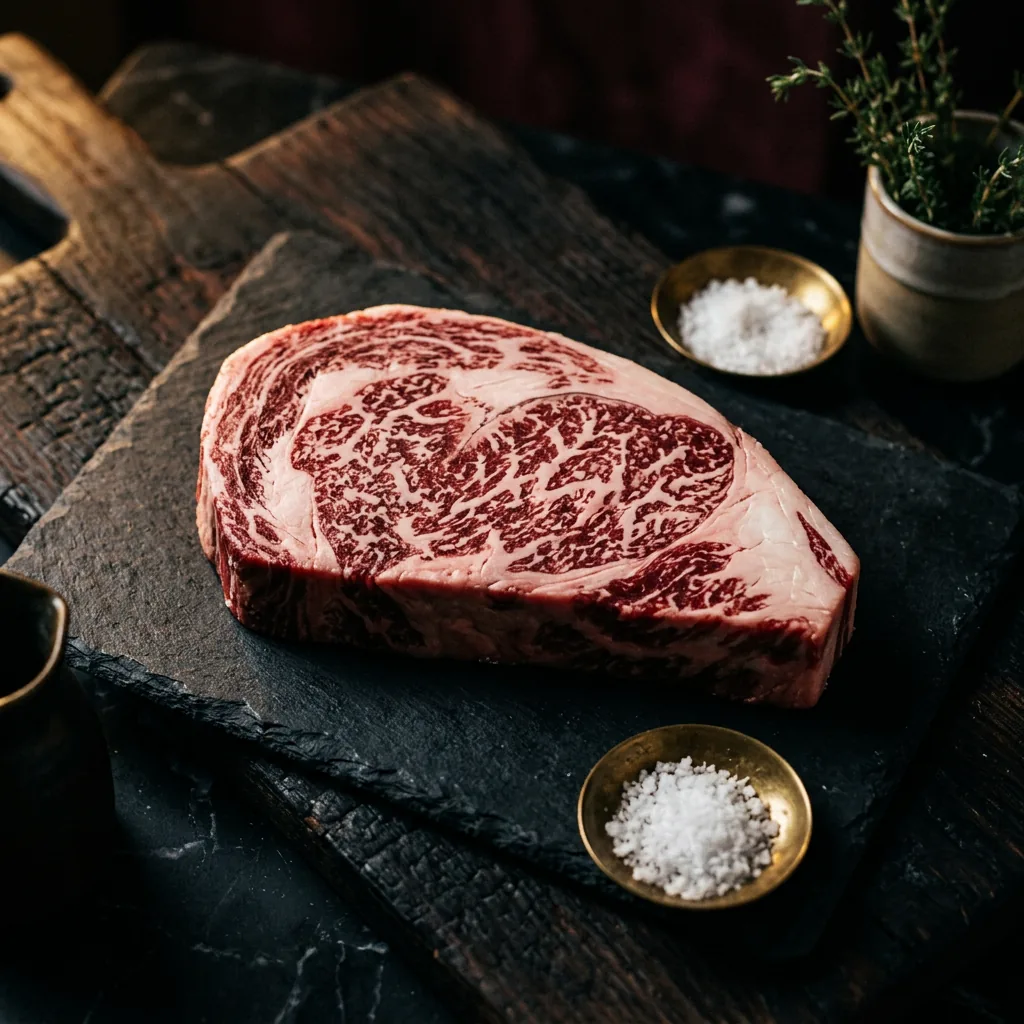
For a wagyu_a5_ribeye, the protocol changes. The abundant intramuscular fat renders almost immediately in a hot pan — no additional oil is needed, and the fat that pools from the steak is itself the basting medium. High-fat cuts sear fast; 60–90 seconds per side at very high heat is the professional target, with the goal being color and Maillard crust without rendering all the precious intramuscular fat into the pan.
Temperatures, Compounds, and the Flavor Map
| Temperature Range | Primary Reactions | Key Flavor Compounds |
|---|---|---|
| 100–140°C | Moisture evaporation, early protein denaturation | None (Maillard inactive) |
| 140–165°C | Initial Maillard condensation, Amadori rearrangement | Aldehydes, early pyrazines |
| 165–180°C | Strecker degradation, caramelization onset | Furans, thiazoles, melanoidins |
| 180–210°C | Full Maillard cascade, pyrolysis begins | Pyrazines, thiophenes, intense color |
| >220°C | Acrylamide formation, bitterness risk | Burnt, acrid compounds |
The practical implication of this table: the sweet spot for Maillard crust development on a pan surface is 180–210°C — above the Maillard threshold, below the pyrolysis zone. A pan measured with an infrared thermometer at 220–240°C is producing conditions just at the upper edge; higher than that and bitterness intrudes.
Pro tip: If your pan is smoking heavily and the steak looks darker than mahogany after 45 seconds, your surface temperature is too high. Move the pan briefly off the burner for 20 seconds, then return. Controlling temperature is as important as achieving it.
What This Means for Every Steak You Cook
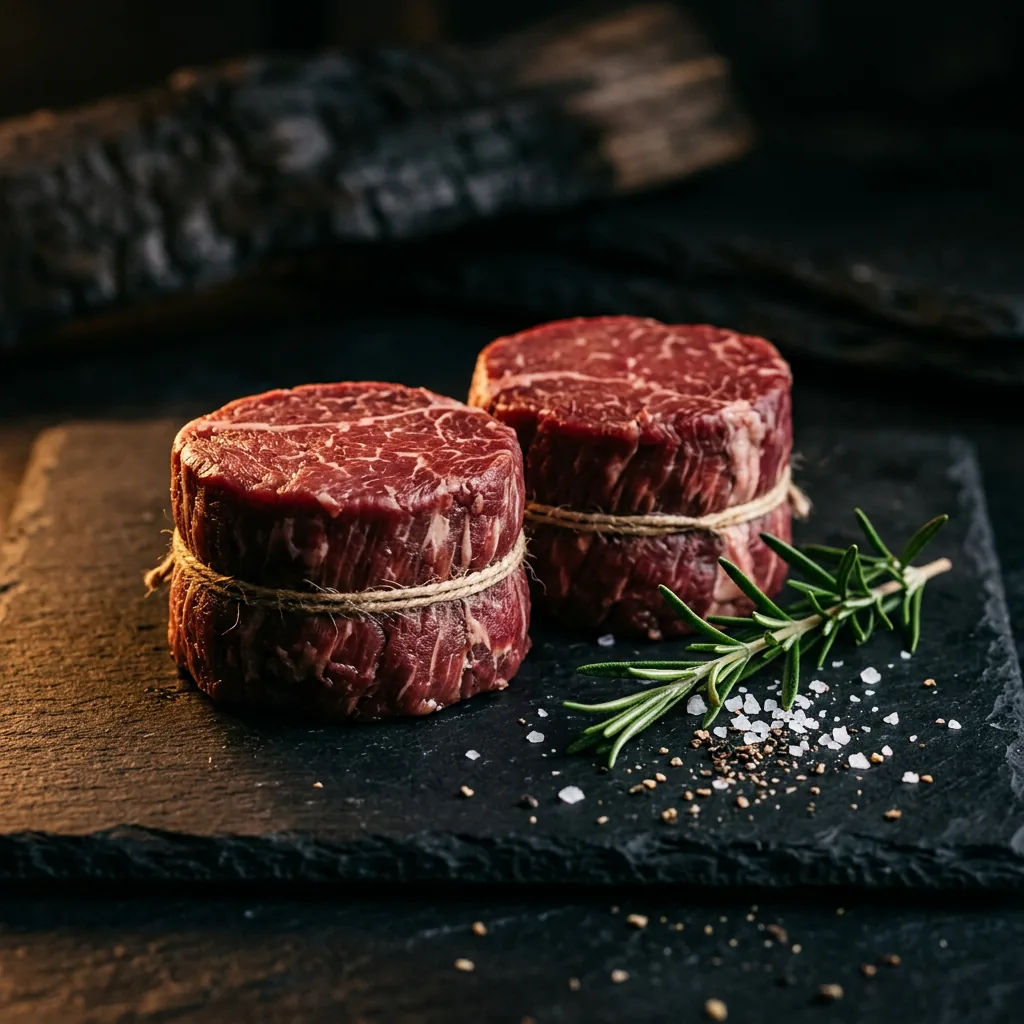
The Maillard reaction is binary in practice: either the conditions are correct — dry surface, ripping-hot pan, high-smoke-point fat — and it happens at full intensity, or it doesn't, and you are producing grey-steamed protein. There is no meaningful middle ground. A modest new_york_strip cooked with disciplined surface preparation will outperform a filet_mignon handled carelessly. The reaction rewards knowledge and preparation, not purchase price.
Master the conditions: salt and dry 24 hours ahead, preheat the pan for longer than feels necessary, use fat that won't burn, and resist the urge to move the steak before color forms. The cascade will do the rest — hundreds of aromatic compounds building in seconds, a crust that no other cooking method can replicate, and a plate that smells like a great kitchen the moment it leaves the pass.
The Bottom Line
The Maillard reaction begins at 140°C, requires a dry surface, and produces the layered complexity that defines great steak cookery. Control the surface moisture, control the pan temperature, choose the right fat, and time the butter correctly — and every cut you cook will carry a crust of genuine depth and beauty. The chemistry is non-negotiable; work with it rather than hoping it will happen regardless, and it will reward you every time.