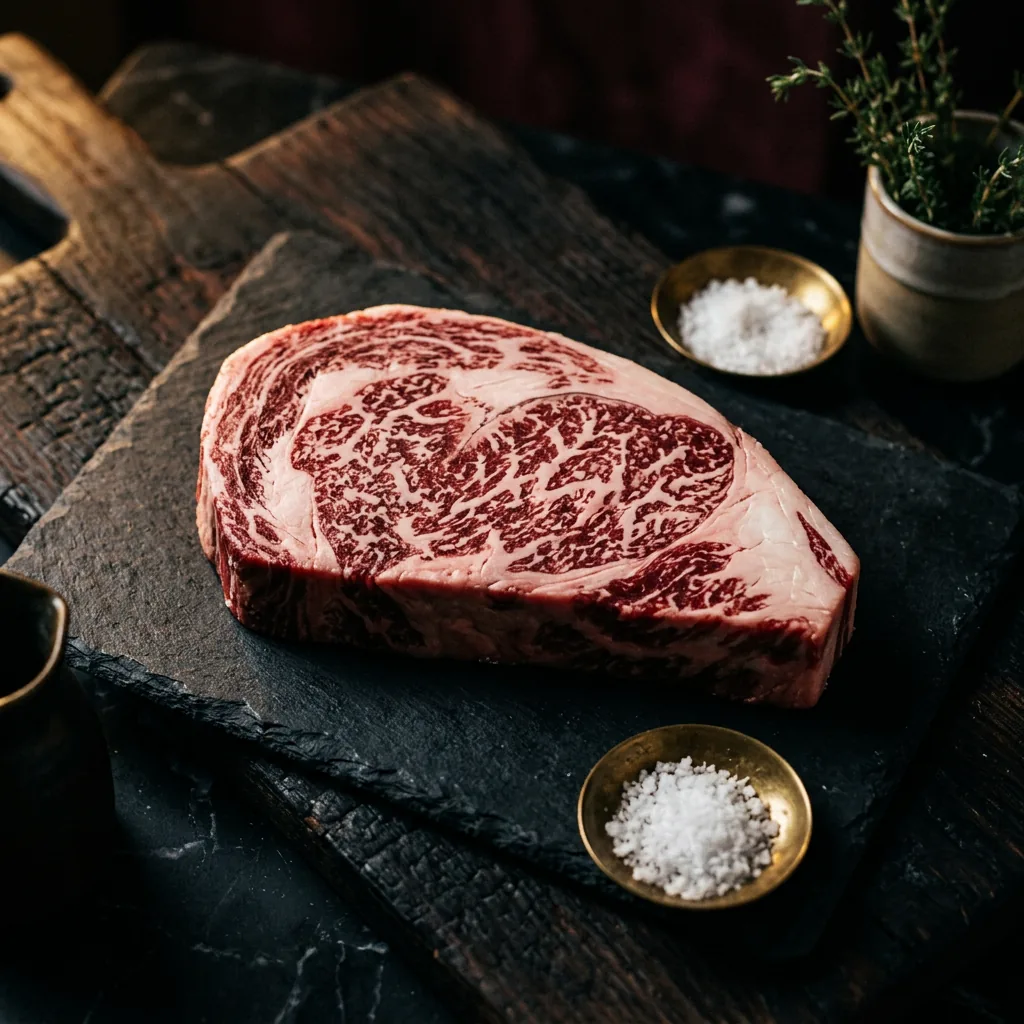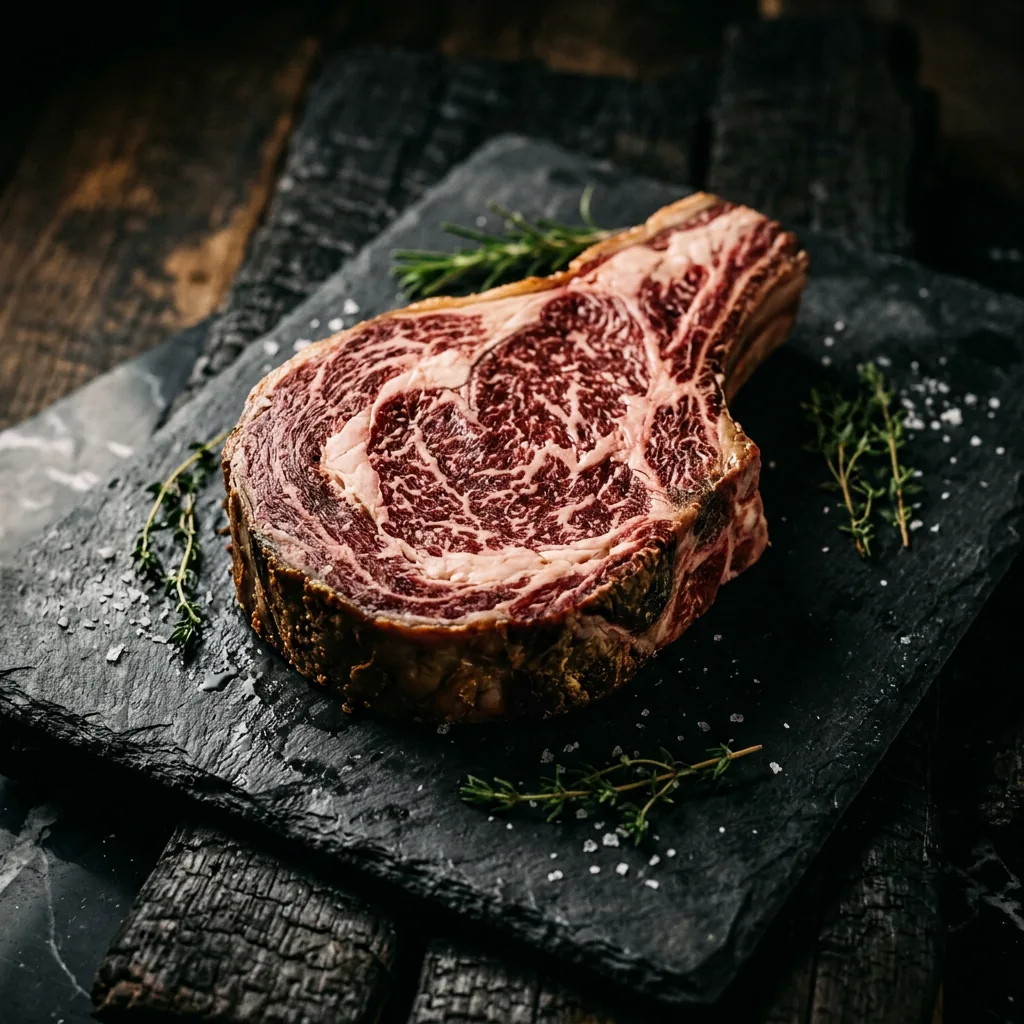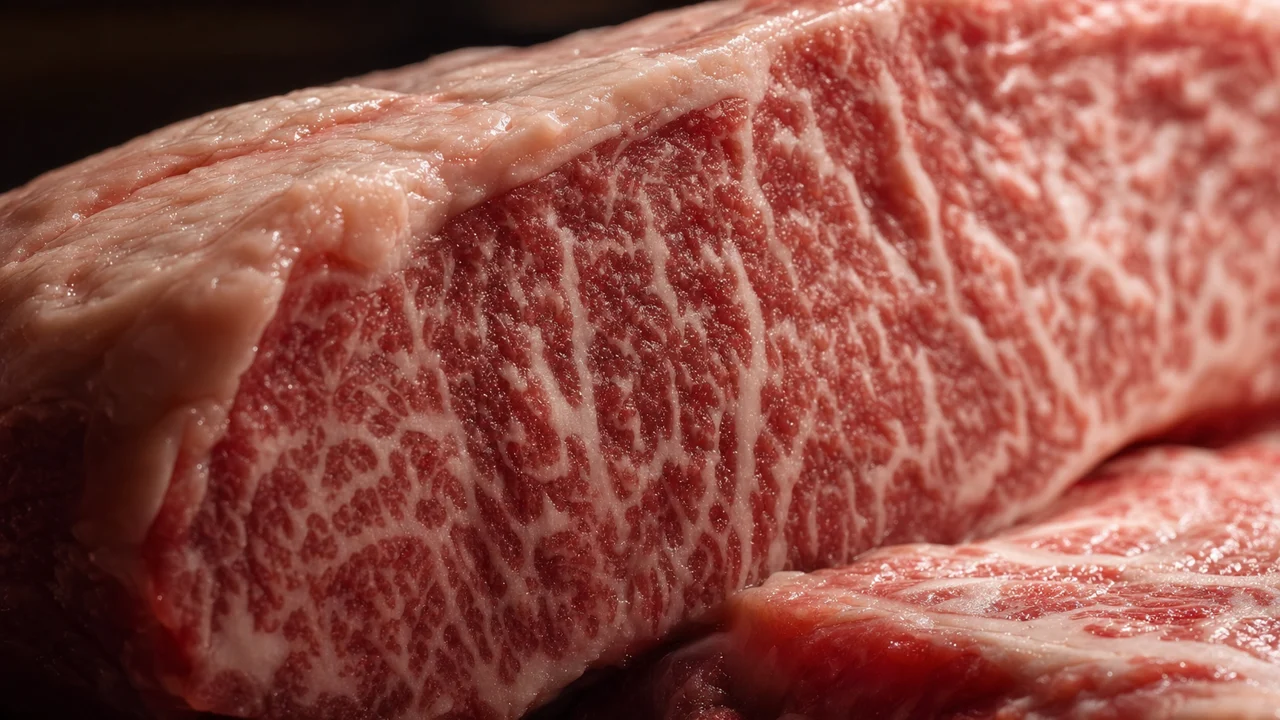
Marbling is the intramuscular fat that threads through a piece of beef in fine, web-like patterns visible on the cut surface. It is not the thick external fat cap on the edge of a steak, not the large inter-muscular fat seams between muscle groups, but specifically the microscopic fat deposits within the muscle fibers themselves — distributed between and around individual muscle fascicles in a pattern that, in the most prized examples, makes the surface of the meat appear as much white as red. During cooking, this intramuscular fat melts progressively as it reaches its relatively low melting point (wagyu intramuscular fat melts at approximately 25–30°C — closer to room temperature than standard cattle fat), basting the surrounding muscle fibers from within and delivering fat-soluble aromatic compounds directly to every bite. It is the single most reliable visual predictor of luxury eating quality in beef, and the Beef Marbling Standard — BMS — is the standardized tool for measuring it objectively.
The BMS Scale: Anatomy of a Number
BMS was developed by the Japan Meat Grading Association and runs from 1 (virtually no visible intramuscular fat) to 12 (the surface of the cut appears as much white as red — fat threads and pools throughout the entire cross-section). In practice, commercial beef rarely exceeds BMS 10; a confirmed BMS 12 is extraordinarily rare and commands prices that reflect its scarcity.
The Japanese grading system pairs BMS with three additional quality metrics to produce the full grade designation. Beef Color Standard (BCS, 1–7 scale) assesses the color of the lean muscle — bright cherry red being optimal. Beef Fat Color Standard (BFCS, 1–7) evaluates the color of the visible fat — clean white being ideal, yellow indicating carotenoid accumulation from pasture feeding or age. Firmness and texture are assessed qualitatively. All four metrics combine into a Quality Score from 1 to 5, and this quality score is then combined with a Yield Grade (A, B, or C — representing the percentage of saleable meat from the carcass) to produce the famous designation:
| Grade | Yield | Quality Score | BMS Requirement |
|---|---|---|---|
| A5 | A (≥72% yield) | 5 | BMS 8–12 |
| A4 | A | 4 | BMS 5–7 |
| A3 | A | 3 | BMS 3–4 |
| B5 | B (69–72%) | 5 | BMS 8–12 |
| C3 | C (<69%) | 3 | BMS 3–4 |
A5 designation — the pinnacle — requires both the highest yield grade and the highest quality score. The "A" is often misunderstood as an absolute quality indicator; it is actually a yield indicator. B5 beef with BMS 10 is eating-quality equivalent to A5 BMS 10 — the difference is yield efficiency at the carcass level, irrelevant to the diner.
How Japanese Grading Compares Globally
USDA grading operates on a different vocabulary and different scoring criteria. USDA Prime — the highest commercial grade — corresponds roughly to BMS 4–5 on the Japanese scale. The very finest USDA Prime specimens from elite Angus programs reach approximately BMS 6, which in Japanese terminology would be A4 territory. The important implication: an item labeled "Prime" at an American steakhouse is not in the same marbling category as a product labeled "A5." They are not competing grades — they are different leagues.
European EUROP grading takes a different approach entirely. It evaluates carcass conformation (muscle development relative to skeleton size) and external fat cover, not intramuscular marbling. A top-grade "U" Charolais or Limousin can carry an excellent EUROP grade with very low intramuscular fat — because European traditional breeds were selected for lean muscle yield rather than marbling. This explains why a porterhouse from a European heritage breed eats differently from a USDA Prime Angus even at equivalent price points: the grading systems were designed around different production goals.
Australian Marble Score (AMS, sometimes marketed as MSA) runs from 0 to 9+ and was developed partly to bring Wagyu crossbreeding programs to a standardized scale. High-scoring Fullblood Australian Wagyu — produced primarily in Queensland and Western Australia — can reach AMS 9+, which corresponds to BMS 8–9 and delivers A5-adjacent eating quality at meaningfully lower price points than Japanese-origin product.
Why Higher Is Not Always Better
The most common error among first-time wagyu buyers is automatic pursuit of the highest available grade. BMS 12 wagyu — the theoretical maximum — contains approximately 45–50% intramuscular fat by composition. The eating experience is extraordinary but fundamentally different from conventional steak: the mouthfeel is overwhelmingly rich, the flavor dominated by butter and sweetness, and a practical serving size for most palates is 80–120g. Beyond that, the richness becomes physiologically overwhelming rather than pleasurable. A BMS 12 wagyu_a5_ribeye is best understood as a flavor ingredient — a Japanese preparation calls for thin slices, minimal cooking, and accompaniment with rice, daikon, and pickled vegetables to cut the fat.
For most European dining contexts — where a full steak experience is expected, perhaps preceded by a first course and accompanied by wine — BMS 8–9 represents the optimal balance. The marbling is still transformative, the flavor profile still categorically different from any USDA Prime product, and the richness is profound but manageable over a 200–250g portion. BMS 7 (A4 territory) is the choice many experienced connoisseurs make for regular enjoyment: enough intramuscular fat to fundamentally change what beef tastes like, but the eating experience remains recognizably and satisfyingly a steak rather than a luxury condiment.
Pro tip: A4 at BMS 7 is, for many experienced connoisseurs, the perfect balance — enough marbling to redefine what a steak can be, but still recognizably a steak. BMS 12 is a pilgrimage experience, not a regular dinner.
Reading Marbling Visually: Three Dimensions
Visual marbling assessment is a learnable skill that directly improves buying decisions at the butcher counter or when ordering online.
Pattern over total quantity. Fine, evenly distributed marbling throughout the entire lean area is the gold standard — the BMS score is partly a measure of distribution, not just quantity. Large, coarse fat pockets between muscle groups (inter-muscular fat) look impressive but render unevenly during cooking: the fat pools and drains from the cut rather than basting the muscle fibers uniformly. The cross-section of a ribeye should show marbling distributed across its entire surface, including the longissimus dorsi muscle and the spinalis (cap). If the marbling is concentrated only at the center or only at the fat seams, the eating experience will be uneven.
Fat color signals diet and age. Clean white or barely-cream intramuscular fat indicates grain-finished young cattle — the expected profile for Japanese Black (Kuroge Wagyu) and high-quality grain-finished Angus. Yellow fat indicates either a predominantly grass-fed diet (the carotenoids in grass pigment the fat) or an older animal. Yellow fat in a product marketed as premium Japanese wagyu is a quality deficiency signal; in a heritage grass-fed breed, it is simply a diet indicator and not inherently negative.
Match marbling intensity to cooking method. High-marbling cuts — particularly BMS 8+ — must be cooked quickly and at high heat to render the intramuscular fat rapidly while keeping the center rare. Long, slow cooking at low temperatures causes the intramuscular fat to melt progressively into the surrounding liquid environment, literally draining the premium from the cut into the pan or bath. Sous vide at very low temperatures (49–54°C) followed by a brief, searing finish is the professional approach for high-BMS wagyu: the fat renders during the sear, not the bath.
Pro tip: For BMS 9+ wagyu, a cast-iron pan at very high heat for 60–90 seconds per side is all the cooking required. The abundant intramuscular fat renders almost instantaneously, and any longer risks turning a transcendent experience into a greasy, over-rendered one.
The Fat Composition Difference: Wagyu vs. Conventional
The reason wagyu intramuscular fat tastes different — not just richer but qualitatively different, with a butterscotch and coconut register that commodity beef fat never achieves — is partly genetic and partly biochemical. Wagyu cattle carry a higher proportion of unsaturated fatty acids in their intramuscular fat compared to Angus or Hereford: specifically, higher oleic acid (the same monounsaturated fat dominant in olive oil), which lowers the fat's melting point and gives it a softer, more liquid character at body temperature. This is why a slice of A5 wagyu begins melting against the palm of your hand — the fat is genuinely closer to a liquid at room temperature.
Grass-fed beef fat, by contrast, is higher in omega-3 fatty acids and conjugated linoleic acid (CLA) and has a distinctly greener, more herbaceous flavor profile. A grass-fed hanger_steak or grass-fed flank_steak does not compete with A5 wagyu for marbling; it offers a different kind of fat quality — leaner, with a mineral and herb-forward character that suits different cooking preparations and different flavor preferences entirely.
The Bottom Line
BMS is a precise, standardized tool for communicating intramuscular fat content — but it is one axis of a multi-dimensional eating experience. The breed, the feed, the fat composition, the aging method, the cut, and the cooking technique all interact with marbling to determine the outcome on the plate. The most important insight: high marbling rewards technical precision and short, high-heat cooking. Pursue the grade that matches your occasion, your portion size, and your preparation — not simply the highest number available. Marbling is a tool, not a trophy.
Japanese Wagyu Breeds and Regional Designations
Four cattle breeds are officially designated as Wagyu ("Japanese cattle") under Japanese law, and understanding them clarifies what the grade actually sits on top of:
- Kuroge Washu (Japanese Black): roughly 95% of all Wagyu production; the primary A5 breed and the genetic carrier of the extreme marbling trait. Virtually all premium Wagyu exported internationally is Kuroge Washu.
- Akage Washu (Japanese Brown / Akaushi): less marbled but with a more robust, mineral-forward flavor; popular in Kumamoto and Kochi, and increasingly used in US crossbreeding programs.
- Nihon Tankaku Washu (Japanese Shorthorn): very limited production; prized for intense umami rather than marbling; rarely exported.
- Mukaku Washu (Japanese Polled): extremely rare, found mainly in Yamaguchi prefecture.
Within Kuroge Washu, regional sub-designations carry enormous prestige and additional certification criteria beyond the BMS number:
- Kobe Beef (Tajima-gyu cattle, Hyogo prefecture): the most internationally recognized designation, with strict additional criteria for birth, lifetime location, carcass weight, and a BMS minimum. Only a few hundred restaurants outside Japan are certified to serve genuine Kobe in any given year.
- Matsusaka Beef (Mie prefecture): virgin-female (heifer) cattle only; the stress-free management and longer feeding period produce a depth of flavor some connoisseurs rank above Kobe. A Kobe certificate is not interchangeable with a Matsusaka one.
- Ōmi Beef (Shiga prefecture): one of Japan's three historic great-Wagyu designations, with records to the Edo period; prized for balance between marbling and beefy character.
The Minimum-Criterion Rule
The single most misunderstood mechanic of Japanese grading: the final quality grade equals the lowest of the four quality criteria, not their average. A carcass scoring 5 on marbling, 5 on color, and 5 on firmness but only 4 on fat color receives Quality Grade 4 — not 5. This is why a genuine A5 is rare even among heavily marbled animals: one underperforming criterion blocks the top designation regardless of how extraordinary the marbling is. Approximately 2–3% of Japanese Wagyu reaches A5 in any given year.
Pro tip: When a menu says "A5 Wagyu" without a BMS score it is technically accurate but incomplete. Ask for the BMS number — an A5 at BMS 8 and an A5 at BMS 12 are vastly different eating experiences, yet both legally carry the A5 designation.
American Wagyu: The Crossbreed Market
American Wagyu is predominantly an F1 or F2 cross (Wagyu × Angus), with full-blood herds at specialist producers such as Snake River Farms (Idaho), Lone Mountain Wagyu (New Mexico), and Double 8 Cattle (Indiana). Producers market with proprietary tiers ("Gold Grade," "American Wagyu Prime," or BMS 6–9 designations). The flavor profile is often described as best-of-both-worlds: generous marbling from Wagyu genetics, robust beefy character from Angus heritage, at an accessible price relative to Japanese imports. For a steakhouse plate where the goal is the most satisfying single steak rather than a composed tasting of extreme fat, American Wagyu is consistently strong value.
How to Read a Wagyu Certificate
Authentic Japanese A5 is sold with a JMGA grading certificate. The fields to check:
| Field | What it verifies |
|---|---|
| Individual cattle ID | Linked to national birth-to-slaughter records |
| Nose print | A biometric identifier unique to each animal |
| Yield grade | A, B, or C |
| Quality grade | 1–5 |
| BMS score | 1–12 |
| Processing date and location | Slaughterhouse traceability |
Without this certificate, "Japanese A5" cannot be independently verified. The nose print — as unique as a fingerprint — is the definitive anti-fraud mechanism. Reputable retailers will display or provide certificate copies on request.
Cooking by Grade
Marbling intensity dictates technique, and the highest grades are the least forgiving:
- BMS 8–9 (A5): serve as a steak, 150–200 g; hot dry cast iron, 60–90 seconds per side; target 52–54°C internal; salt only — no oil, the fat renders immediately.
- BMS 10–12 (A5 extreme): thin-sliced (2–3 mm) for yakiniku or shabu-shabu; 80–100 g portions; never beyond 55°C internal — the fat is the flavor and renders in seconds.
- Australian MS 7–9: treat like premium Western beef, but cook 5–10°C cooler than standard beef; the marbling renders quickly.
- American Wagyu BMS 6–8: can be cooked more conventionally and benefits from a proper 5-minute rest.
Across every grade the rules are the same: minimal seasoning, never marinate, and never cook Wagyu beyond medium. Overcooked, greasy fat is the most common Wagyu failure mode in restaurants and home kitchens alike.