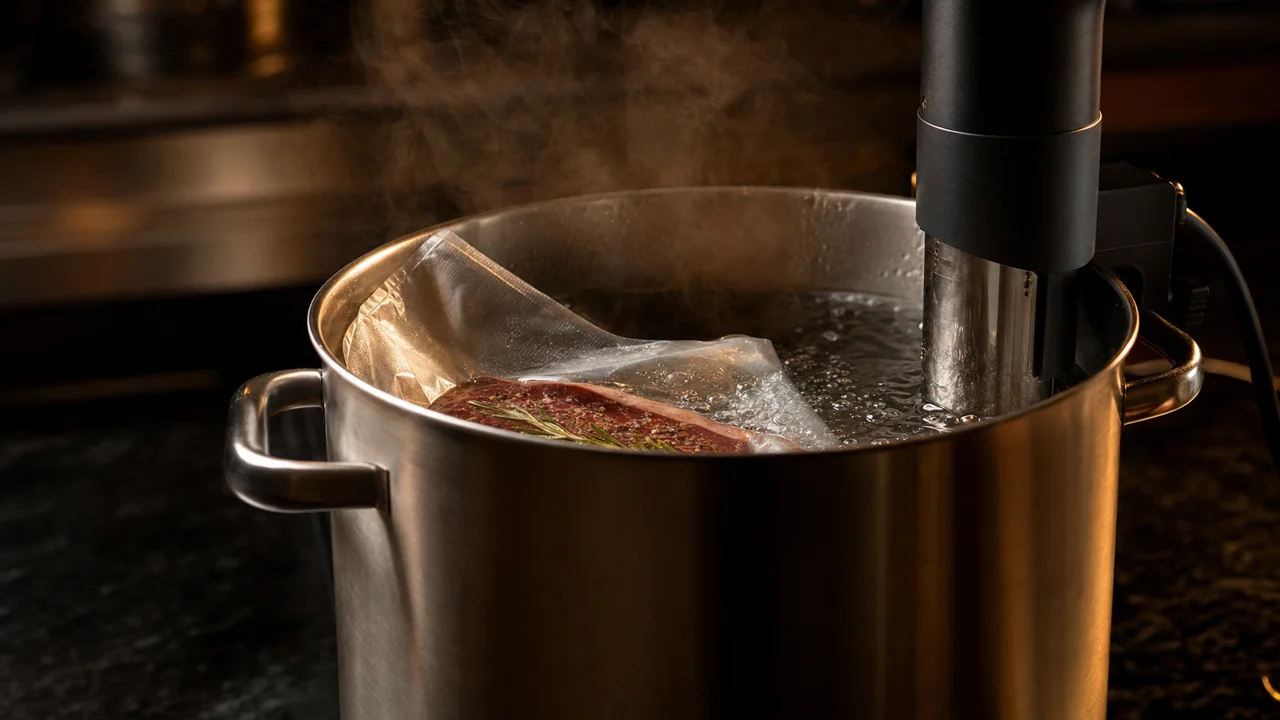
Sous vide is French for "under vacuum," and in professional culinary contexts it refers specifically to cooking food — sealed in a plastic bag with the air removed — at a precisely and consistently controlled water temperature for a defined period. The technique was not invented by a gadget company. It emerged from 1970s French haute cuisine, where Pierre Troisgros used it to cook foie gras without the texture-destroying moisture loss of traditional methods, and where Georges Pralus refined it for the same goal. Joël Robuchon and other three-Michelin-star kitchens adopted it across protein categories throughout the 1980s and 1990s, and for three decades it remained exclusively behind the pass of the world's most technically demanding restaurants. The consumer immersion circulator — a device capable of maintaining a water bath at ±0.1°C — changed that permanently. Sous vide is now the single most reliable technique available to any cook for achieving precise, repeatable doneness in meat. Understanding exactly what it does, why it works, and where its limits lie is what separates genuine mastery from disappointed expectations.
The Physics: Why Temperature Control Changes Everything
Traditional cooking is a race against a gradient. When a steak enters a 230°C oven or a 220°C cast-iron pan, heat transfers from the outside in. The surface of a 3 cm steak can reach 180°C while the center sits at 35°C; the cook's task is to remove the meat at the precise moment the center hits the target temperature before the outer layers overcook further. The window in which this is possible is narrow — a matter of seconds for thin cuts — and it closes continuously as the center rises and the outer band of overcooked grey meat widens.
Sous vide eliminates this race by definition. Set the water bath to 54°C and the steak — whatever its thickness — will rise to 54°C throughout, plateau there, and then hold indefinitely at that temperature. It cannot overcook past the bath temperature, because there is no heat source hotter than the target. The thermal gradient that defines every other cooking method simply does not exist once the meat has equilibrated. The result: time becomes forgiving in a way that is structurally impossible in any other method.
This resolves three long-standing technical problems simultaneously:
- Overcooking is eliminated. A 4 cm steak at 54°C for 1.5 hours and the same steak at 4 hours are both medium-rare. The window is measured in hours, not seconds.
- Edge-to-edge doneness becomes achievable. The grey band visible in pan-seared steak — the zone of overcooked protein between the crust and the pink center — does not exist. The entire cross-section reaches the same temperature and holds it.
- Moisture retention is maximized. At 54°C, protein contraction is far less severe than at the 80–100°C surface temperatures of traditional cooking. Myosin denatures at approximately 50°C, actin at 65–70°C. Below 60°C, the structural proteins that cause moisture expulsion are only partially contracted, which is why sous-vide beef at 54°C is measurably juicier than oven-roasted beef at the same final temperature.
Temperatures and Times: The Practical Chart
Temperature determines doneness; time determines texture (through collagen conversion in tougher cuts) and the degree of pasteurization achieved. For premium beef cuts, the temperatures are:
| Doneness | Bath Temperature | Core Character |
|---|---|---|
| Rare | 49–51°C | Translucent red center, very soft |
| Medium-rare | 54°C | Warm red center, firm but yielding |
| Medium | 58°C | Pink center, noticeably firmer |
| Medium-well | 62°C | Slight pink, firm throughout |
| Well-done | 68°C | Grey throughout, maximum moisture loss |
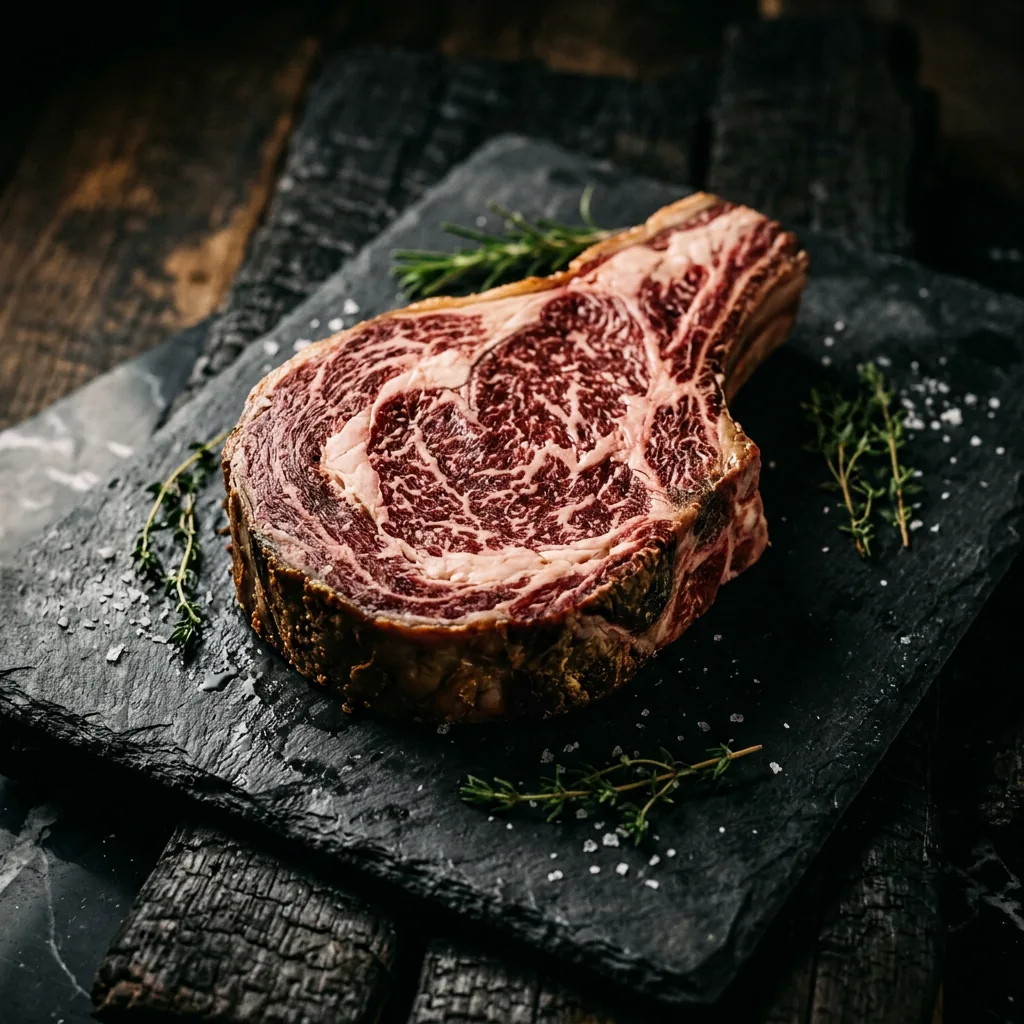
Time minimums for standard cuts: a 2.5 cm ribeye requires at least 45 minutes to reach full thermal equilibration at bath temperature; 90 minutes improves texture without any negative effect. A 4 cm tomahawk or similar thick-cut needs 2.5–3 hours. A critical food safety note: below 54.4°C, the USDA considers beef safe only if the time at temperature achieves pasteurization by holding duration — specifically, 4 hours at 54°C is the outer edge of the recommended safety window for whole-muscle cuts. Above 54.4°C, the pasteurization time-temperature curve becomes rapidly more favorable.
For tough, collagen-rich cuts, sous vide is uniquely transformative. Short ribs at 60°C for 48 hours: the collagen converts to gelatin progressively over the long cook, producing a texture simultaneously tender enough to eat with a spoon and structurally intact enough to slice cleanly — a result impossible with any shorter method. Brisket at 68°C for 24–30 hours yields unctuous, pull-apart texture with none of the dryness that high-temperature braising can introduce. At 74°C for 48 hours, short ribs achieve a coarser, more shredded texture closer to traditional braised results. The ability to dial in the exact texture by varying time and temperature gives sous vide its extraordinary range across both tender premium cuts and tough braising cuts.
Pro tip: For tough cuts like short ribs, the long time is the point — not a compromise. 48 hours at 60°C produces gelatin from collagen without the muscle fibers fully seizing, achieving a texture that no other method can replicate at any time scale.
The Sear: Non-Negotiable Completion
Sous vide produces perfect internal doneness and zero crust. When the bag opens, the surface of the meat is wet — wetter than a fresh steak pulled from the refrigerator, having spent hours in a warm, humid environment. The Maillard reaction, which requires a dry surface above 140°C, has not occurred at all. The sear after sous vide is not an optional finishing step; it is the completion of the dish, and it must be executed with the same precision as the bath.
The sequence: Remove the steak from the bag. Dry aggressively with multiple changes of paper towel. Rest uncovered on a wire rack for 5–8 minutes; the combination of patting and brief open-air rest will desiccate the surface measurably further. A cast-iron or carbon-steel pan, preheated for 5–8 minutes over maximum heat with a thin film of refined avocado oil or grapeseed oil (smoke point ≥215°C). The steak goes in and comes out in 60–90 seconds per side — maximum. The goal in the pan is exclusively crust development; the interior must not change. Butter, garlic, and thyme in the final 30 seconds of the sear, basting rapidly.
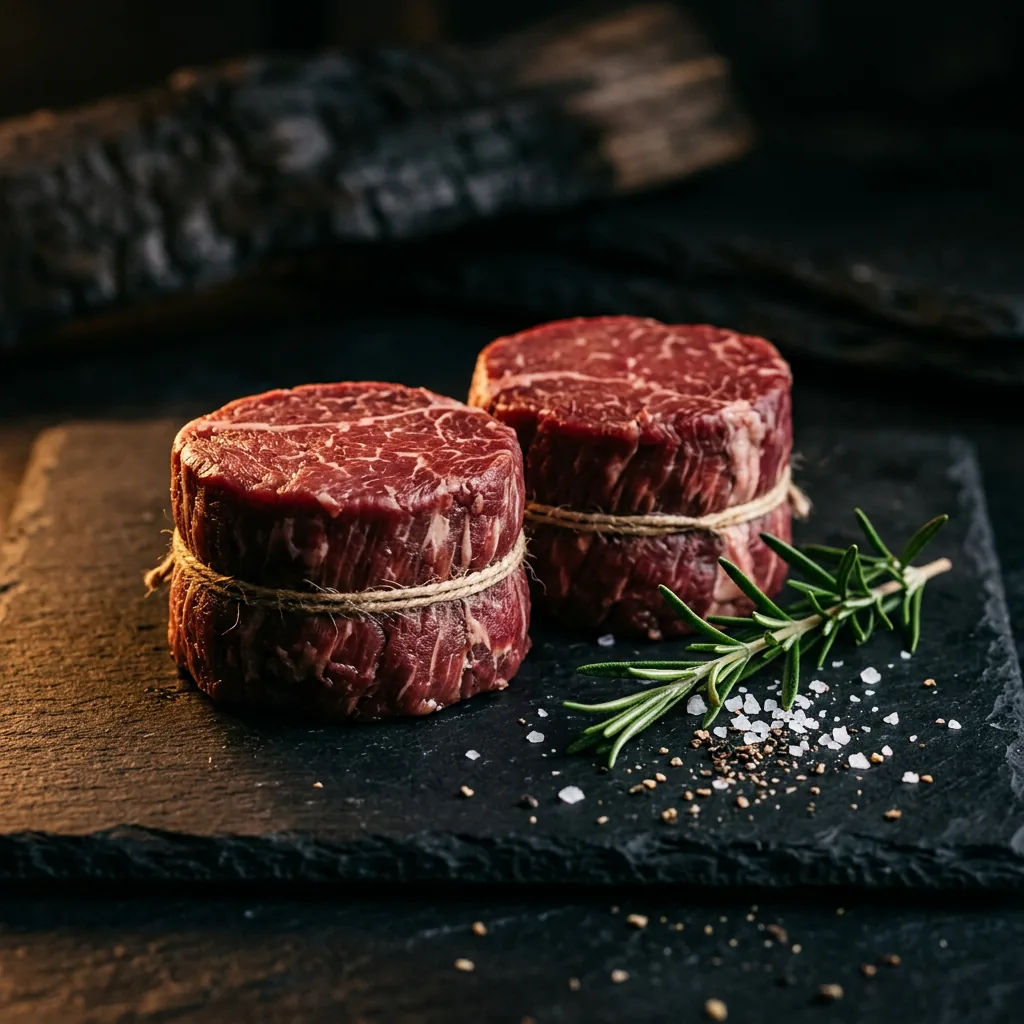
For a filet_mignon — where the delicate, mild flavor is the entire point — the post-sear must be executed with particular discipline. A filet in a screaming pan for more than 90 seconds per side will cook the outer layer past the bath temperature you so carefully maintained; the sous-vide advantage is partially erased. Sear hard, sear fast, and stop.
Pro tip: The pan should be smoking visibly before the steak touches it. The crust must form in under 90 seconds per side. Any longer and you are cooking the interior past the bath temperature you maintained so carefully — the entire point of the technique begins to erode.
Seasoning in the Bag: What Works and What Doesn't
Seasoning protocol for sous-vide beef is counterintuitive compared to traditional methods. Salt applied before bagging and equilibrating for at least 40 minutes — or overnight — seasons the meat thoroughly and has no deleterious effect on texture at standard bath temperatures. Fresh garlic in the bag at temperatures below 54°C is a food safety concern (the warm, anaerobic environment is favorable to Clostridium botulinum) and is therefore omitted; garlic is added to the pan during the sear, not the bath. Butter added to the bag does function as an insulator and changes heat transfer characteristics slightly, but the effect is minimal for cook times over 1 hour.
Aromatics like thyme, rosemary, and bay leaf in the bag at moderate temperatures (54–60°C) are effective flavor contributors, particularly for longer cooks — the extended contact time allows volatile compounds to migrate into the meat surface. For short cooks of 60–90 minutes, the effect is modest and the aromatics serve their purpose primarily during the sear.
The Honest Limits
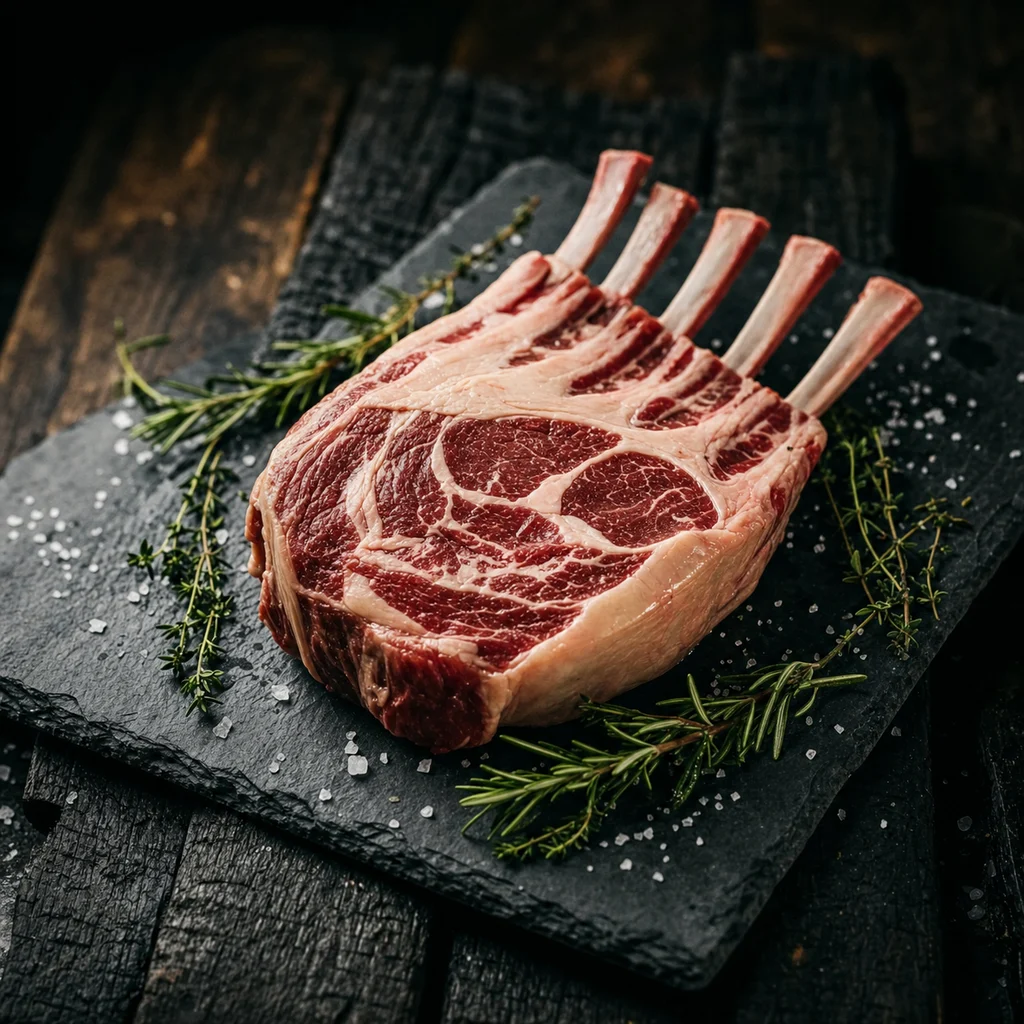
Sous vide does not develop crust, smoke, char, or the mineral-roasty sub-surface complexity that a very hot dry-heat sear creates in the millimeters just beneath the browned crust — a zone of flavor that exists in pan-seared steaks but not in sous-vide ones. Used purely as a technique in isolation, sous vide produces texturally perfect but flat-tasting beef. Used with a disciplined, very high-heat sear executed correctly, it produces results that combine perfect internal doneness with a crust that would satisfy any steakhouse standard. The combination is, for thick premium cuts like a bone-in prime_rib portion or a 4 cm ribeye, the most powerful and controllable technique available.
The Bottom Line
Sous vide's power is temperature precision at scale — it removes the narrow, forgiving window of traditional cooking entirely and replaces it with hours of latitude. Master the bath temperature for your target doneness, respect the minimum time for thermal equilibration, and treat the post-sear with the same seriousness as the bath itself. The technique is unforgiving of a poor sear in the same way it is forgiving of an extra hour in the bath — but get both right, and the result is consistently and reproducibly the best steak you have ever made.