Doneness is chemistry, not intuition. At 50°C, beef is barely altered from its raw state; at 100°C, it is uniformly grey, fibrous, and has expelled most of its available moisture. In between, every five-degree increment produces a measurable, predictable change in protein denaturation, moisture retention, and textural character. Understanding what happens at each temperature threshold transforms cooking from an approximation based on experience into a reproducible technical process — the difference between cooking by feel and cooking by knowledge.
Protein Denaturation: The Molecular Mechanism of Doneness
Beef muscle is composed of several distinct protein families, each with its own denaturation temperature — the heat threshold at which its folded three-dimensional structure unfolds and loses the molecular organization that defined its texture and moisture-holding capacity.
The two proteins that govern most of the cooking experience are myosin and actin. Myosin — the primary motor protein responsible for muscle contraction — denatures between 50°C and 54°C. It is structurally fragile relative to actin and is the first major protein to respond to heat. Actin — the scaffolding protein that myosin pulls against during contraction — is far more heat-stable, denaturing fully around 65–70°C. Between these two denaturation events lies the entire interesting territory of steak cookery. Below myosin denaturation, the steak is still effectively raw at its center. Above actin denaturation, it has expelled most of its moisture and entered the dry, grey territory of well-done. The window between 54°C and 65°C — where myosin has coagulated but actin remains largely intact — is where every quality-conscious cook is trying to land.
Collagen, the connective tissue protein found in varying densities across muscle groups, operates on a completely different timescale. It begins converting to gelatin around 60°C, but meaningful conversion requires sustained time at temperature — hours rather than minutes. This is why a short braise at 80°C accomplishes nothing with a brisket, while 12–14 hours at 107°C transforms it completely. The collagen-rich cuts and the tender steak cuts are literally cooked in different dimensions.
Temperature by Temperature: What Is Actually Happening
- 40°C — Extra-rare / bleu: Minor denaturation of heat-sensitive proteins begins. The center is still translucent and deep red, essentially warm raw meat. Appropriate only for a very specific tradition and for premium cuts where raw protein quality is itself the point.
- 50–52°C — Rare: Myosin has fully denatured. The center firms from translucent to opaque and deep, vivid red. Maximum moisture retention, since actin is still intact and the muscle fibers have not expelled significant free moisture.
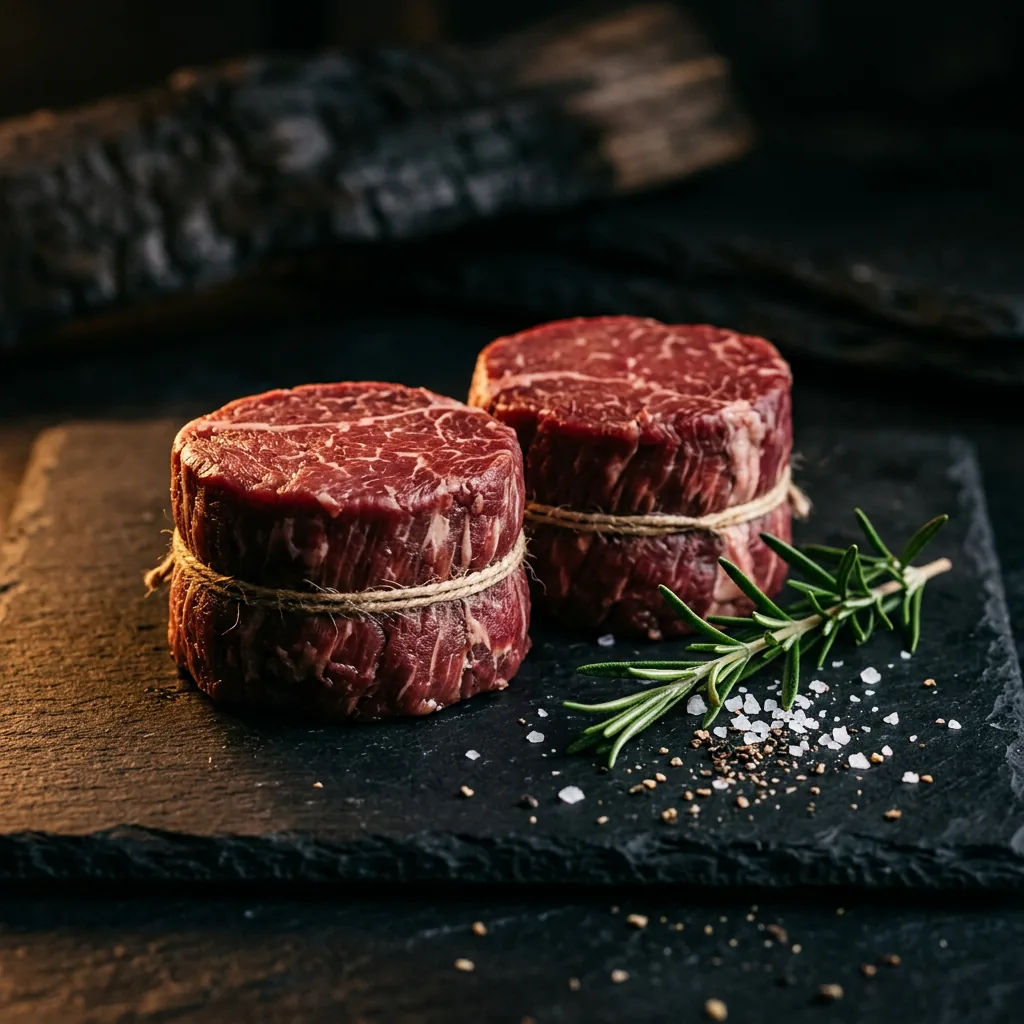
- 54–57°C — Medium-rare: Myosin fully denatured; actin has begun denaturing but has not fully coagulated. The inflection point of steak cookery — the brief window where both structure and juiciness are simultaneously optimized. For a ribeye, a filet mignon, a new york strip, or a tomahawk, this is the target.
- 58–60°C — Medium: Actin denatured more significantly; meaningful moisture expelled. For well-marbled cuts — ribeye, prime rib — intramuscular fat compensates for some moisture loss. For leaner cuts, medium reveals dryness noticeably.
- 63–65°C — Medium-well: Actin fully denatured. The bulk of available free moisture expelled from muscle fibers. For most experienced cooks, the threshold at which a premium cut is technically compromised.
- 71°C+ — Well-done: USDA benchmark for whole-muscle food safety. Nearly all moisture expelled; texture firm and dry. Justified for ground beef where pathogen risk is distributed throughout.
- 85°C sustained (2–14 hours) — Collagen conversion: Dense collagen networks in brisket, short ribs, oxtail, and beef cheek convert fully to liquid gelatin, producing the fall-apart texture that defines great low-and-slow cookery. Only appropriate for cuts with sufficient collagen.
| Temperature | Doneness | Protein State | Moisture Retention | Appropriate Cuts |
|---|---|---|---|---|
| 40–48°C | Extra-rare / bleu | Myosin partially denatured | Maximum | Tender premium cuts only |
| 50–52°C | Rare | Myosin fully denatured | Very high | All tender cuts |
| 54–57°C | Medium-rare | Myosin done; actin beginning | High | All tender cuts: optimal |
| 58–60°C | Medium | Actin significantly denatured | Moderate | Well-marbled cuts |
| 63–65°C | Medium-well | Actin fully denatured | Low | Not recommended for premium |
| 71°C+ | Well-done | All proteins denatured | Minimal | Ground beef; food safety |
| 85°C+ sustained | Collagen conversion | Collagen → gelatin | Redistributed | Brisket, short ribs, oxtail |
Why Medium-Rare Is the Universal Benchmark
At 54–57°C, myosin denaturation has provided the structural firmness that distinguishes a cooked steak from warm raw protein, while actin remains mostly intact and preserves the muscle fiber's moisture-binding capacity. The steak holds its juice not because the juice has not been released, but because the protein matrix has not yet contracted enough to expel it. This is the inflection point: rise above it and the juice exits; fall below it and the texture is insufficiently structured for most palates.
The window is approximately five degrees — which is why temperature measurement matters so much and why the "touch test" is an inadequate substitute for any situation beyond routine, familiar cuts cooked by an experienced hand on familiar equipment.
Pro tip: Five degrees separates an excellent steak from an apologetic one. Pull at 3–4°C below your target to account for carry-over, rest mandatorily, and use a quality instant-read thermometer. Intuition and experience are built on accurate measurement, not the other way around.
The Thermometer: Not Optional, Not a Beginner Tool
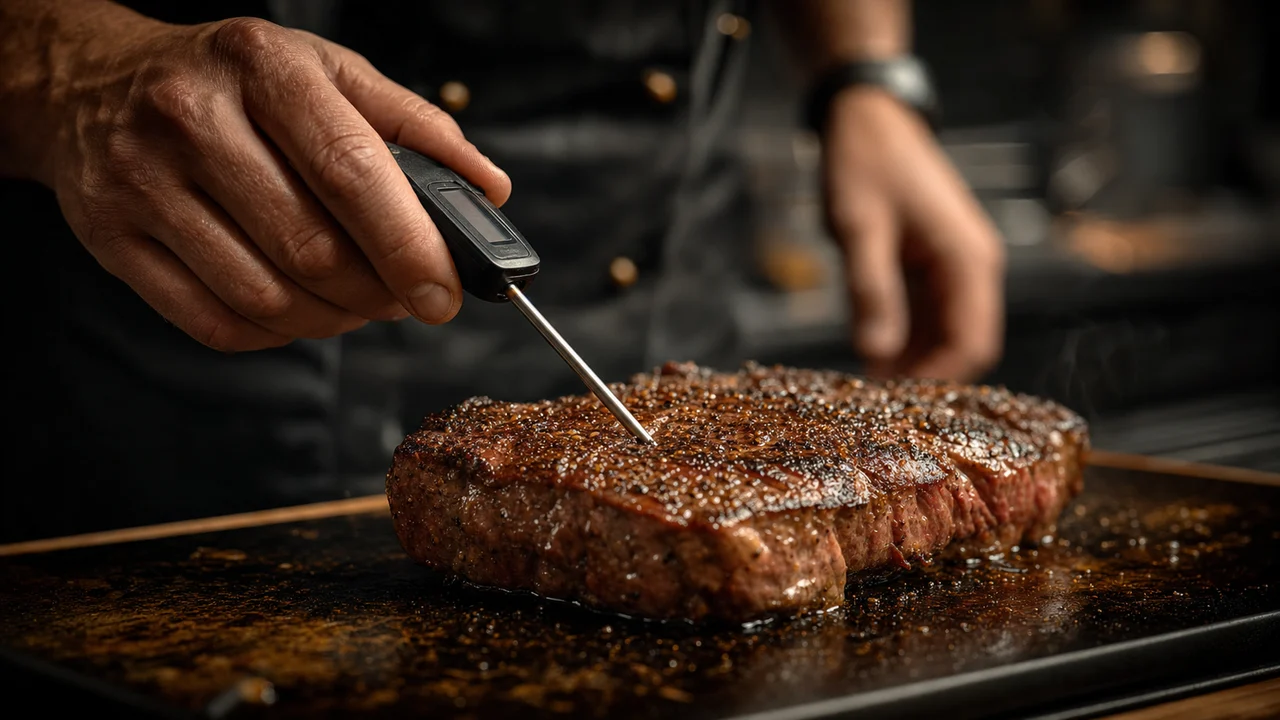
Every chef who has spent time in a serious professional kitchen uses an instant-read thermometer. The touch test works as a rough heuristic on familiar cuts of familiar thickness cooked by a cook with hundreds of repetitions on identical equipment. It fails systematically for thick cuts over 4 cm, for bone-in cuts where bone conducts heat differently than muscle, for dry-aged cuts with a denser exterior, and for any cook without a substantial library of precise tactile memory. A quality instant-read thermometer costs €25–50 and eliminates the majority of overcooked-steak outcomes permanently.
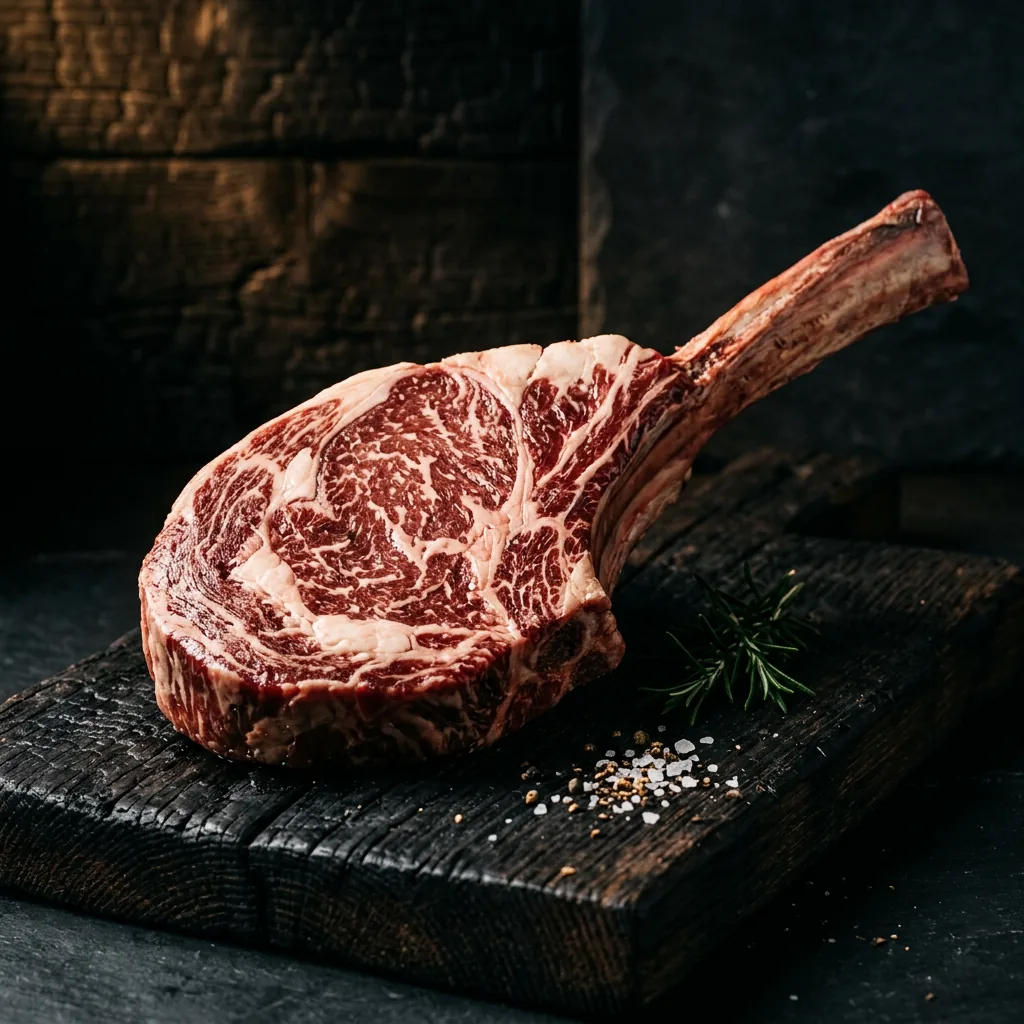
Insert the probe horizontally into the geometric center of the thickest part of the cut, parallel to the cooking surface, away from bone (which conducts heat faster than muscle and gives false high readings) and away from fat seams. For a tomahawk with its long rib bone, measure where the probe is farthest from the bone. Read once the number stabilizes.
Pro tip: For cuts over 3.5 cm thick in a reverse-sear protocol, leave the probe in place during the low-heat oven phase and watch the temperature climb in real time. Observing the climb over 30–45 minutes, followed by the carry-over rise after removal, is the fastest way to build accurate intuition for what your specific oven and cut thickness will do.
Cut-Specific Temperature Exceptions
The universal targets apply to most beef cuts, but several contexts require specific adjustment:
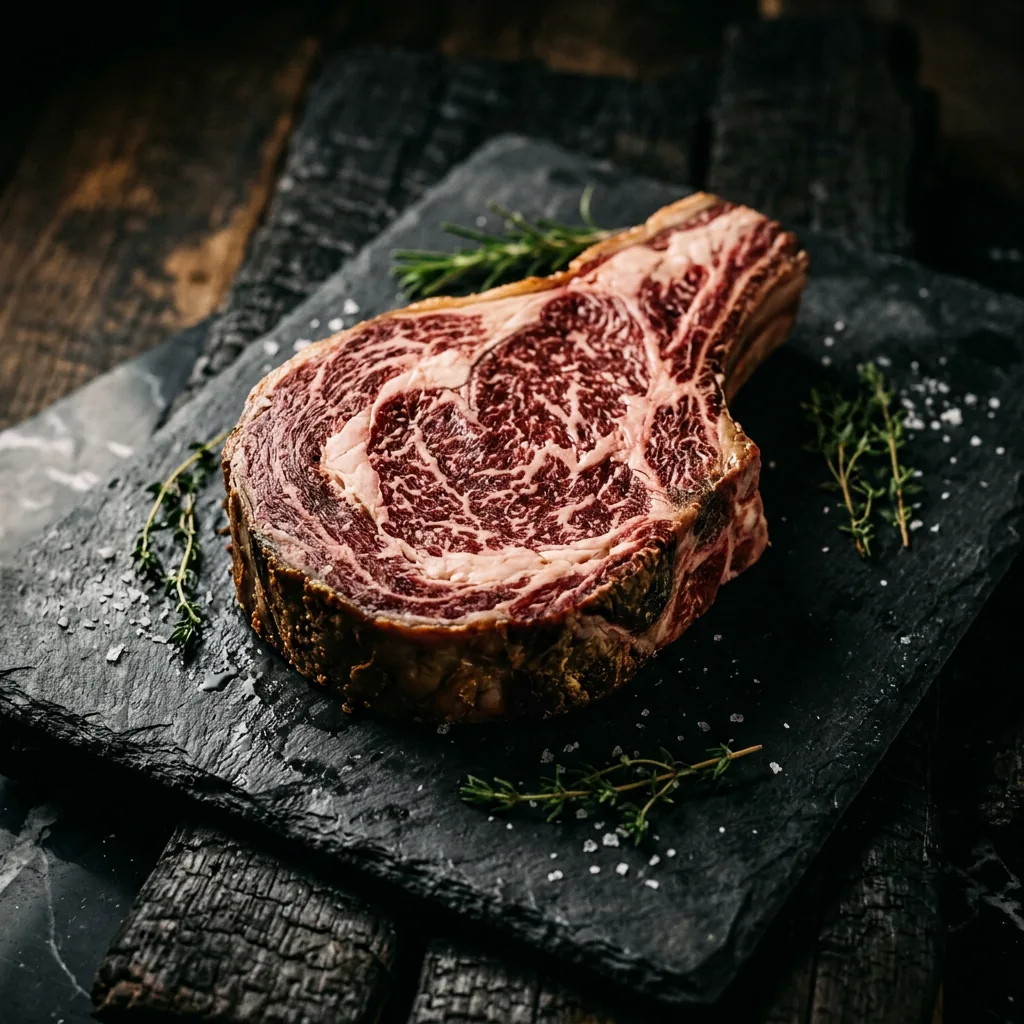
Wagyu A5: Target 50–52°C. The intramuscular fat in wagyu a5 ribeye renders aggressively above 55°C, becoming excessively liquid and coating the palate in a way that reads as greasy rather than luxurious. Pull early, serve immediately on a warm plate.
Lamb: Can tolerate 58–62°C without meaningful quality loss. Lamb fat is compositionally different from beef fat — higher in saturated fatty acids and more heat-stable. A lamb rack at 58°C is optimal; shoulder preparations can go to 60–62°C.
Pork: USDA revised its whole-muscle pork recommendation in 2011 to 62°C — well below the outdated 71°C standard that produced a generation of dry pork chops. Trichinella is eliminated at 58°C; modern commercial pork is rarely even exposed. A pork loin roast at 63°C is safe, pink, moist, and a completely different eating experience from one cooked to 71°C.
Game meats: Venison loin, venison tenderloin, and wild boar loin are extremely lean — the margin between properly juicy and dry is narrower than any domestic beef cut. Pull at 52–54°C and rest immediately. Above 58°C, the texture deteriorates rapidly to dry and fibrous with startling speed.
Carry-Over Cooking and the Mandatory Rest
Carry-over cooking is not optional physics. When a piece of meat is removed from a heat source, the exterior is significantly hotter than the interior. Heat continues to migrate from the outer regions toward the center by conduction, raising the internal temperature 3–8°C depending on the thickness of the cut and the temperature differential. A 4 cm ribeye pulled from the pan at 52°C will reach approximately 56°C at the center after a 5–8 minute rest. Account for this every time.
Resting also allows muscle fibers — contracted from heat — to partially relax and reabsorb some of the moisture that migrated toward the cooler center during cooking. A steak cut immediately off the heat loses significantly more juice on the cutting board than one rested for 5 minutes on a warm plate. The difference is visible, measurable, and meaningful.
Summary
Temperature control is the master skill of meat cookery because every sensory quality of the finished dish — texture, juiciness, color, mouthfeel — is a direct function of the internal temperatures reached and the time spent there. Myosin and actin denaturation define the steak experience; collagen conversion defines the braise. The 54–57°C window for medium-rare is a scientific optimum, not a preference. Measure precisely, pull early for carry-over, rest mandatorily, and apply cut-specific adjustments where protein chemistry demands. The thermometer is not an admission of inexperience — it is the instrument of expertise.